The 2025 Review of the Wood

It is now six years since we took on twelve acres of lovely mixed woodland on the edge of the Barham Downs near Canterbury. We still have a lot to learn but every year we take a few steps forward in our understanding and appreciation of the place, and here are my highlights for 2025:

Green Woodpeckers

Green woodpeckers once more nested in the old cherry tree, using the same low hole that they dug out last year.

The two adults at the nest in the beginning of May

Before long, however, there was this worrying photo of an adult flying from the nest carrying what appears to be a complete egg:

Perhaps the egg got trodden on and cracked? There certainly wouldn’t have been much manoeuvering space in there

At the end of May there was another unwelcome photo, this time of an adult carrying a chick out of the nest:

I presume that this chick had died

However, even with the removal of the egg and the chick, two demanding youngsters remained:

Then, very early one morning at the end of June, one of the young woodpeckers fledged out of the hole, stretching its wings into the big wide world for the very first time:

There is always an adult nearby when the chicks fledge, presumably giving them the confidence to emerge

The remaining chick stayed in the tree for a couple more days…

…before it too left the nest. Unfortunately the trail camera failed to capture the second fledging.

The spotty juveniles were then seen on trail cameras throughout the wood for the next few weeks bringing another green woodpecker breeding season to a satisfactory conclusion:

Dormice

2025 was the first full year for which I have held a licence from Natural England to disturb dormice. I certainly got a lot of practice because there were good numbers of dormice in the boxes and they seem to have had a good year, in our wood at least. The wood is part of the National Dormouse Monitoring Programme and, by the last tour of the year in November, twenty-five of the thirty boxes had dormice nests in them. Most of these were unoccupied by then but at some point during the year all those twenty-five boxes had had a dormouse living in them.

John the birdringer’s photo, taken when he and his wife accompanied us on the May tour round the boxes. He has taught us so much about birds over the years that I was delighted to be able to show him some dormice in return
Dormice are absolutely beautiful animals but there has been a horrifying 70% decline in their UK population since 2000. Much conservation work is ongoing to try to identify and solve the problems
Several litters of young dormice were found in the boxes this year

There are often other interesting things found in the dormice boxes. A wren nest was in box 28:

A male wren will build five to twelve unfinished nests and then escort his female round them so that she can choose the one that they will then finish building and lay eggs in. She selected the nest in box 28 and they raised their young in there, leaving one unhatched egg in the box

The lid of box 3 was stuck down with a dense silken mesh and inside was a labyrinth spider, Angelena labyrinthica. These very large spiders build big funnel webs to catch their prey in low vegetation. But when it is time for the female to produce her egg sac, she will create a labyrinth of impenetrable webbing to protect the eggs. Unfortunately she sometimes chooses to do this in a dormouse nest box.

The female labyrinth spider in box 3

Yellow-necked mice will also sometimes nest in the dormice boxes. This pair had a nest with young in box 25

Every year we also find pygmy shrews living on the top of abandoned dormice nests:

It is easy to miss the tiny shrew on the side of this box

Dormice are thought to drink dew from leaf surfaces in the early hours of the morning and also get moisture from their food of fruits, berries, flowers and insects. It is most unusual for them both to come down to ground level and to use ponds to drink, but this summer a trail camera was often catching them at one of the woodland ponds:

The Pond in the Marjoram Clearing

Before our time at the wood, water was only occasionally available in small pools that formed in the centre of some of the coppice stools. We rapidly dug two ponds, but both are in the heavy shade of the trees and have remained rather dank and lifeless. They do provide somewhere for birds and mammals to drink and bathe, but we also wanted a pond where a healthy freshwater ecosystem could establish to support the tadpoles of woodland amphibians.

In January 2023 we dug a new pond out in the open of a clearing where the marjoram grows. It has proved a popular destination for larger birds, but I think the smaller birds do still prefer the other ponds that are less exposed:

Sparrowhawk standing on the frozen pond
Tawny owl bathing in the pond in mid December

The first sign that amphibians have now started using the pond was when we saw a heron extracting a frog from it in early February:

I worried that perhaps the heron had eaten the only frog but, towards the end of February, it was exciting to see that the wood’s first ever clump of frogspawn had been laid. A momentous moment indeed:

However, unfortunately I don’t think that the resulting tadpoles fared very well this year. For a start, the weather was often hot and dry and the water level got very low. But something else rather wonderful happened as well – a tadpole predator took up residence under the corrugated green square, placed by the side of the pond to increase its water catchment area. This was the first time that I had ever seen a snake on a trail camera:

A grass snake swimming in the pond
We saw the snake by the pond several times in the spring and early summer, by which time I was fairly sure there were no tadpoles left in the water

This is an awful photo but this pair of mallards, stopping in at the pond in April, were a new species for the wood:

The other new bird species seen in the wood this year was a redstart in September bringing the wood bird list to 47

I am delighted by the way that this small, simple pond has improved the habitat and biodiversity of the wood. Over the winter we are going to add another green square on the other side of it to increase its water-catching ability and hopefully improve the chances for the tadpoles next year.

Other Birds in the Wood

A dry spell at the beginning of the year allowed birds’ muck to accumulate under the stand of silver birch at the centre of the wood – a clear sign that the wood is still being used as a winter crow roost:

We feel very privileged to have tawny owls living in the wood:

A tawny owl bathing in the wood this summer

Back in 2022 a pair of tawny owls nested in one of our owl boxes and fledged two young:

One of the Johns is licensed to ring owls and ringed these two chicks in our wood back in May 2022. John’s photo. This remains an all-time highlight but sadly has not been repeated since then
May 2022

The tawnies did again show interest in the box this spring..

…but once more lost out to the squirrels. When the squirrels had finished with the box, a pair of stock doves moved in and raised two broods over the summer:

There has been bird ringing in the wood this year. Marsh tits have declined by 81% in the UK between 1967 and 2023, so the breeding population in the wood is very precious:

Marsh tit being ringed in August this year. John’s photo

We know they are breeding here because a brood was successfully raised in dormouse box 12 last year:

Marsh tits about to fledge in May 2024

I think the peanut feeder in our wood must bring in great spotted woodpeckers from far and wide because John often seems to get them in his net:

Assessing the flight feathers of a juvenile great spotted woodpecker in August. John’s photo

And bullfinch is another species of bird that breeds in the wood every year:

A pair of bullfinch in the water and one of their recently-fledged chicks, yet to get its black head feathers, is on the right

Other Mammals in the wood

Plenty of mammals live in the wood other than the dormice. Our part of the wood doesn’t contain a major badger sett, but we do still see plenty of badgers:

We also have a population of foxes. Back in 2022 the dog alerted us to an old rabbit burrow that was being used by a family of foxes. I immediately got a trail camera on it:

The fox family in April 2022
April 2022

We have not been so fortunate since then although foxes are still clearly raising their cubs there:

A lactating vixen in May this year
One of this year’s cubs with its mother in June

The UK rabbit population has seen a major decline in recent years for several reasons including rabbit haemorrhagic disease virus. It is difficult to assess the number of rabbits currently living in the wood but unfortunately there don’t seem to be very many:

The rabbits are prey for the woodland’s resident population of foxes and buzzards. Occasional mustelids have also been seen this year who love to eat rabbit when they can:

Our trail cameras caught a mustelid several times in the second half of the year. None of the photos however were good enough to be able to identify it categorically as a polecat, a feral ferret or a hybrid between the two. Our woodland neighbour, however, did much better:

Our neighbour’s trail camera photo of a polecat/ferret hybrid in her wood in October

Invertebrates and Plants in the wood

I had long wanted to be able to run a moth trap in the wood and finally took the plunge and bought a battery-powered moth trap this year. In the event I only ran it there once but this is something that is very much on the agenda for 2026.

This wonderful male black arches moth with amazing antennae is a woodland specialist and was in the trap in August

The Kent county recorder for micro moths visited the wood in October to survey it for leaf mines. Because there are so many different species of tree, he managed to record fifty-seven different species of moth leaf mines, often more than one species on a single leaf. He also found other signs of moth activity of which we had previously been totally unaware, such as the larval case of a bagworm on the left below and the tiny orange wood balls excavated by a cherry tree tortrix moth larva on the right:

It was all completely fascinating stuff and we hope to take great strides forward on the subject of woodland moths next year.

We are much more familiar with the butterflies that are to be found in the wood. The large and fabulous silver-washed fritillaries feed on the flowers growing in the marjoram clearing in July and August:

They earn the ‘silver-washed’ in their common name because of the coloration on the underside of their wings:

The larvae of this butterfly feed on the violets that grow well in the shade of the trees

White admirals are also sizeable, although this one looks like it has had some near misses:

The larvae of these butterflies feed on the leaves of honeysuckle. Honeysuckle is a very important plant in the wood – its stripped bark is used by the dormice to weave into their nests and the long tubes of honeysuckle flowers feed long tongued moths and bees. Bats then hunt around the honeysuckle at night to catch those moths. The berries are also eaten by birds and small mammals including dormice

Another plant that grows very well in our wood at the beginning of the season is the primrose.

Dark-edged bee-fly feeding on the nectar of primroses in April. Other than the bee-flies, brimstone butterflies are the only insect on the wing in the early spring that have a long enough tongue to feed from the many thousands of primroses that carpet the ground

In June we were in the wood with a friend who has a good macro camera. He photographed a bee that we think is a white-bellied mining bee, Andrena gravida. This is quite an exciting bee for the UK:

Martin’s photo of the white-bellied mining bee

Tree bumblebees built a nest in one of the bird boxes this year:

In August I photographed a most peculiar-looking fly – the waisted bee-grabber, Physocephala rufipes, which is shown below:

If it weren’t for those fly eyes, I’d never have guessed that this was a fly at all. It is an endoparasite of bumblebees

This pellucid hoverfly, Volucella pellucens, seen in August and looking very much like Humpty Dumpty, is also a fly but its shape couldn’t be more different to the waisted bee-grabber:

There are always lots of bizarre-looking scorpion flies to be seen in the marjoram clearing in the summer:

We often find glow-worm larvae in the wood, such as this one seen in June:

Another thing on the agenda for 2026 is to visit the wood just after dark on a warm, still evening in June or July. This is in hope of seeing adult female glow-worms advertising their position to the males by glowing in the undergrowth.

My final photo is of one of the many white helleborines, a woodland specialist orchid, that appeared this May:

We would normally expect to find one or two white helleborines in the wood each spring, but this year was an extraordinary year for them and we found at least forty.

It was been another wonderful year of discovery in the wood. We are hoping to get some clearing and coppicing work done this winter and then will wait to see what 2026 brings. A very Happy New Year to you.

A Local Wildlife Site

Local Wildlife Sites are areas of land that have been identified as being especially important for wildlife and its habitats, and there are almost five hundred of them in Kent and forty thousand of them across England. They can be both public and private land which supports biodiversity, provides corridors and acts as a buffer to protect nature from surrounding land use.

The number of Local Wildlife Sites so far across England is broken down by area below:

Taken from The Wildlife Trusts website. Kent has 476 sites but Hampshire is doing particularly well with 4,132

And the percentage of land per area that is part of a Local Wildlife Site is shown here:

Also from the Wildlife Trusts website. 7.1% of the land in Kent is part of a Local Wildlife Site

On Monday we had the fantastic news that, with much help from Kent Wildlife Trust, the meadows have now been designated a Local Wildlife Site, as an extension to the existing Kingsdown and Walmer Beach Local Wildlife Site. Nothing much will change as a result, but it is a wonderful grande finale for the year.

I have to admit that the allotment ran away with us this summer and got wildly out of control. We are weeding and composting it now, so that we can start afresh next year with renewed good intentions. One day Dave half-weeded one of the raised beds, intending to finish it off the next day. In the morning we noticed large feathers on the soil and, without investigating too closely, supposed that a pigeon had come down to peck around the newly overturned soil and fallen victim to a sparrowhawk.

The raised bed where the feathers had appeared

When Dave returned to finish the weeding, though, he was very surprised to find a large duck-sized bird that was now buried just below the soil, which had then been beautifully smoothed back over. The bird had no head or feet so we are not completely sure what species it is – I think it was probably a duck though:

We had never stumbled upon a fox’s cache before. I read that they do bury excess food and usually take great care to disguise high protein prey such as this bird. Interestingly, when a fox returns to remove the cache, it will often urinate at the site as a kind of bookkeeping exercise so that it will know that it has emptied the cache even though it might still be able to smell the food.

I trained a trail camera onto the cache site and, two nights later, the fox retuned to collect the bird:

Although whether or not the bookkeeping urination occurred has not been recorded for prosperity by the camera.

John the bird ringer has been ringing in both the meadows and the wood recently. Rather extraordinarily, in the last three recent seasons in the meadows he has caught seven firecrests:

One of the firecrests was a retrap (now called a ‘subsequent encounter’). It had previously been ringed in the meadows on 28th November but had now put on a bit of weight and muscle. This is good news because it suggests that the firecrest is overwintering here and is doing very well on it.

He has also recently ringed several long-tailed tits in the meadows:

One of the long-tailed tits was also a subsequent encounter and has an amusing history. It was first ringed as a juvenile in June this year at Sandwich Bay Observatory just to the north of here. It was then recaught four times at the observatory – once in August, twice in September and once in October. You can imagine that perhaps it got a bit fed up with constantly finding itself in the ringers’ net and decided to move south to try its luck elsewhere, only to find itself once more in a net in the meadows. I wonder if we will see it again before too long?

It is unusual to catch a wren in the nets and it was lovely to see this one:

John has caught this wren twice now

Lots of measurements and observations are made before a bird is ringed and released:

There is a lovely blue sheen to the wing and tail feathers of a blue tit

I did not know that you can sex a great tit by looking at the width of the black stripe down its front. This is a male with a wide black stripe and the female would have a much narrower one:

It is now thought that all the blackcaps that are here during the summer will then migrate south for the winter. They are soon replaced with other blackcaps from the more northerly parts of Europe, arriving in the autumn to overwinter in this country. John caught one of these overwintering blackcaps this week:

On a recent sunny day, we toured the meadows to clear old bird nests out of the nest boxes. It is sometimes a bit of a struggle to remember where all the boxes are, but we managed to find eight boxes that had been used this year:

I think that these are all great tit and blue tit nests. We did also have swifts and house sparrows nesting in boxes attached to the house but we haven’t got round to those yet

Several of the boxes had been commandeered by snails to hibernate in:

A female gypsy moth had taken up residence in another box. Ignoring the snail, you can see the whole life cycle in the photo below. The hairy caterpillar is top right and the large, smooth brown cocoon is below it. The white flightless adult female is now deceased and lying just above the cocoon and snail. Finally, her brown furry egg mass is to the left of the photo:

The female adult moth will have released pheromones to attract a male into the box to mate with her before the eggs were laid. The gypsy moth is an unwelcome new arrival in this country but they are here now and there is nothing to be done about it. However, all the same, I think we will remove those eggs

Other interesting photos from the meadows this week:

I include this rather fogged up trail camera photo because it shows the rear end of a stoat – only the third time we have seen one here
A lizard hibernating in a pit under a reptile sampling square
A tiny Luffia moth larva feeding on lichen on some rope. This moth has a really strange life cycle because, other than in Cornwall, only the flightless female is known – there are no males and reproduction quite happily goes on parthenogenetically without the need for one. In Cornwall, however, there are winged males
In the south of England, buff-tailed bumblebees attempt a third generation, often relying heavily on winter-flowering plants in gardens
We do have winter-flowering heathers and mahonia to offer them at the moment and it was lovely to see these plants being used by the bees this week

I heard from our woodland neighbour that she had just seen a hawfinch in her wood. John the bird ringer was ringing in our wood the very next day but sadly didn’t see or hear a hawfinch. He did, however, hear crossbills throughout the morning. Eventually twenty-two of them landed in a nearby tree and he got fantastic views. He doesn’t carry a camera but here is a photo of two male crossbills from Wiki Commons:

These birds are fir cone specialists, but the ones John saw in the wood this week appeared to be foraging on an oak tree. Photo by Elaine R Wilson under CCA-SA 3.0

Occasionally we do hear shooting in the environs of the wood and so perhaps these pheasants are seeking sanctuary amongst the trees where the guns can’t go:

The new pond in the marjoram clearing has been getting a lot of visitors recently. A sparrowhawk here:

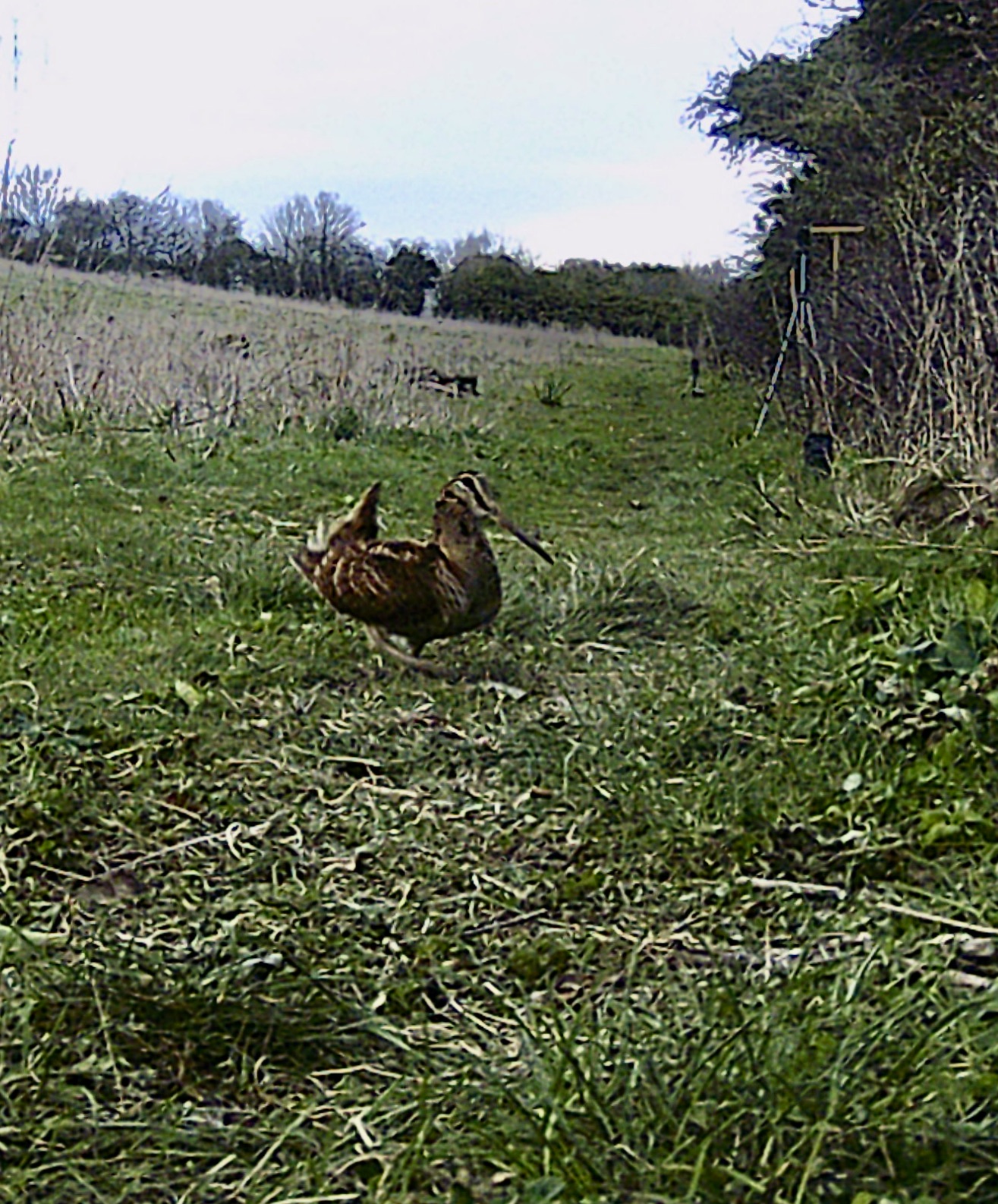
And lots of night time woodcock:

Even a tawny owl is regularly bathing there still:

A lovely woodland night time scene

Tomorrow’s winter solstice is the very deepest point of winter and is always eagerly anticipated here. From that point on the days are gradually getting longer and there is an indefinable feeling of change in the air. Like our ancestors for centuries before us, we are planning to mark the day by lighting some candles out in the meadows, celebrating a special day where light starts to win out over the darkness.

My Family’s Wildlife Year

Now that the wildlife is mostly tucked away for the winter and all is quiet out there, it is time to turn my attention to reviewing my wildlife highlights for 2025. It is truly a labour of love to trawl through the photos taken in the meadows and the wood over the past twelve months and come up with a selection of the most interesting. I will be using these in my reviews of the year coming soon! Before I start that, though, I first asked my family to send me their most memorable wildlife photo of the year. It was fun to see what they came up with, and I now present these to you here.

We have five children and I start with the youngest, Lizzie, who went truffle hunting with Gianfranco and his dog Mina in Piedmont, Northern Italy, in October.

Mina is a Lagotto Romagnolo, a breed of dog known as the best truffle hunters in the world, and she dug up four white truffles whilst Lizzie was with her. The truffle is the fruiting body of a fungus that grows underground, forming a symbiotic relationship with the tree roots. It needs to be eaten in order to disperse and so develops an appetising smell which gets stronger as it matures. By October, the aroma is detectable above ground by animals with a keen sense of smell such as badgers and wild boar. They will dig them up and eat them, then spread the truffle spores in their droppings.

Jonny, who moved to Brighton this autumn, took himself down to the seafront at dusk and captured the Brighton Piers’ starling murmuration on his phone.

The murmuration at the Palace Pier. There is the ruined West Pier at Brighton as well, at which the birds also roost

Before they left for Brighton, our daughter-in-law Hayley got amazing video footage of up to ten red kites who came to tea in their back garden in Maidenhead after she had thrown some scraps out. Red kites generally feed by swooping low, grabbing the food with their feet and not landing on the ground. However, at Hayley’s red kite tea party that afternoon most of her visitors eventually landed down onto the lawn:

Our daughter Sally has sent this photo of a rose-crowned fruit dove that she thought was the most beautiful bird she’d ever seen. It lives high in the canopy of the rainforests of Northern and Eastern Australia and Southern Indonesia and eats various fruits from the trees and vines. This is not where she saw it though – she saw it in a zoo in Honfleur when she was on holiday with her family in France this summer:

Her husband Adam found a very large elephant hawk moth caterpillar in their garden in Kent in August. The species was apparently given this common name because of the caterpillar’s resemblance to an elephant’s trunk:

But when he gently nudged it with a twig, it rapidly transformed itself into something that looks a lot more scary:

Our other son Jonty, together with his wife Ellie, accompanied us to Elmley Nature Reserve on the Isle of Sheppey back in January where we stayed overnight in shepherds huts in the heart of the reserve. We were most unfortunate though because Storm Herminia was in full swing whilst we were there, meaning that we saw very little wildlife and got very wet. By way of consolation, the wildlife guide showed us where there was a magnificent long-eared owl roosting in some deep cover. This is a bird that Jonty and Ellie had never seen and of which we had never before got such good views:

The four of us are going to try again and are returning to Elmley next month, hoping for better weather this time.

In the depths of December’s gloom, it is impossible not to be cheered by Ellie’s photo below of buff-tailed bumblebees. It was taken in July in the gardens of the large crop protection company she works for near Maidenhead:

Our eldest child Sarah moved with her family to Cornwall this summer. However, she and our little grandson stayed with us in Kent last week and visited Wingham Wildlife Park where a Bornean orangutang put on a good show for them:

All three species of orangutang are now critically endangered and zoo populations are crucial, serving as vital insurance populations and genetic reservoirs. They can also be used to raise awareness of the habitat loss due to palm oil plantations which is one of their biggest threats.

Sarah also took this photo on her phone of a hummingbird hawkmoth when visiting Trelissick gardens near Truro in Cornwall:

These lovely moths feed from the nectar of tube-shaped flowers, using their long proboscis and whilst hovering in the air – they are notoriously difficult to photograph and have frustrated me many times, even with the speed whacked right up on my camera.

We are looking forward to getting to know Cornwall’s distinctive wildlife a bit better as we visit Sarah and her family in the coming years.

My brother likes Cornwall too and he sent me this photo of a grey seal haul out on the Roseland Peninsula in Cornwall in February. What a lovely sight this is:

He also took this photo of a grey heron from the back door of his home in Somerset:

His wife, Julie, found this beautiful moth, a scarlet tiger moth, in their Somerset garden in May. It has a largely westerly distribution and I haven’t ever seen one of these:

She also found a garden tiger moth caterpillar at Three Cliffs Bay on The Gower in South Wales in April. It looks really quite extraordinary, like a piece of old badger fur:

One of my brother’s sons is in a different league to the rest of the family as far as wildlife photography goes. He lived in the US for several years before moving back to England this summer. Before he left, he took this photo of a bull moose in the Rocky Mountains National Park, Colorado:

And this amazing photo is of a subadult grizzly bear in Yellowstone National Park in Wyoming:

My sister’s wildlife photo of the year is of a lovely mallard’s nest that they found at the bottom of their garden in Berkshire this spring:

This was not an ideal spot for the mother duck to have chosen and they were worried about how she was going to lead her ducklings to the river once the eggs hatched. In the end, however, this wasn’t an issue because sadly the nest was abandoned.

My sister does have another wildlife photo, this time taken inside her house. Although this was actually in October 2024, it was so astonishing that I’ve included it anyway. She had the french windows open that day and a polecat wandered into her sitting room and had a poke around:

There are quite a lot of dogs in the family and one of my sister’s daughters actually now has three. Here is lovely little Skye who she took in to temporarily foster this year and of course ended up keeping her:

I finish this round up of my family’s wildlife year with Dave and my favourite photos. Back in May, we were with the Amphibian and Reptile Trust who were showing us the reptiles and amphibians of Dorset as part of a four day holiday. The smooth snake is Britain’s rarest snake and Dave never dreamed that he would ever see one, let alone actually hold one. This image of him with a smooth snake is his photo of the year:

Smooth snakes are only found on heathlands in Dorset, Hampshire and Surrey. It is a non-venomous constrictor, coiling up around its prey of sand lizards, slow-worms, insects and nestlings to subdue them, often crushing them to death.

In June we caught the sleeper up to Aberdeen and then the overnight ferry on to Shetland. The Shetland Isles are remote from the rest of the World and, as a result, some species have evolved in isolation and are now only found there. Before very long at all I had fallen in love with the Shetland bee:

Only found on Shetland and the Western Isles, the Shetland bee is strikingly large and intensely coloured, and is quite simply an absolute corker.

Shetland also has its own wren subspecies. Since there are so few trees to hide within on the islands, the Shetland wren is used to being out in the open and is easy to photograph:

This wren is darker than the mainland form with a longer bill and stronger legs.

I have very much enjoyed pulling together this collection of my family’s wildlife photographs for 2025. They should now be forewarned that I will be asking them again next year, so hopefully they will be ready with some more good ones!

Woodcocks and Blackbirds

John the bird ringer sent me this photo of a woodcock that his son had found resting on the deck of his ship, not far off the Norwegian coast.

The bird could well have been heading to the UK to spend the winter, but it’s not a good sign that it needed to stop off on the ship because there is still a long way for it to go. John suggested to his son that he put some minced meat out for it but we haven’t yet heard how that went. A few years ago his son also had a snowy owl on his ship which must have been a pretty amazing sight

 Although the woodcock is very obvious on the red deck of the ship, it is normally exquisitely camouflaged, disappearing from view when roosting by day on a leaf-strewn woodland floor.

A trail camera photo of a woodcock in the wood this week

There is a small population of woodcock that breed in this country but their numbers are boosted a hundredfold in the autumn when birds from north-east Europe and Russia arrive here to enjoy our milder winters. Every year a fair number come to our wood and we enjoy night time trail camera photos of them throughout the winter until they leave again in the spring.

November 2023

Back in November 2018 Dave discovered that one of these lovely birds had flown in off the sea and unfortunately straight into his study window, breaking its neck. The fact that it had just arrived at its destination after a long and arduous journey across Europe and the North Sea made the whole thing even more sad.

Note the very tips of its tail feathers are grey when viewed from above like this. Photo from November 2018
But when turned over, you can see that the tips of these same tail feathers are startlingly white when viewed from the underside

The underside of a woodcocks tail feathers are very white indeed. In fact they are 30% brighter than the white on any other bird, since it uses them for courtship display at night. The grey upperside, however, ensures that its daytime camouflage is not compromised. Below you can see the grey upperside and the white underside of the tail feathers:

Although these overwintering birds won’t be displaying whilst in this country, I do have trail cameras footage of them flaring their tail up to reveal the white. Photos from February 2021 and March 2023:

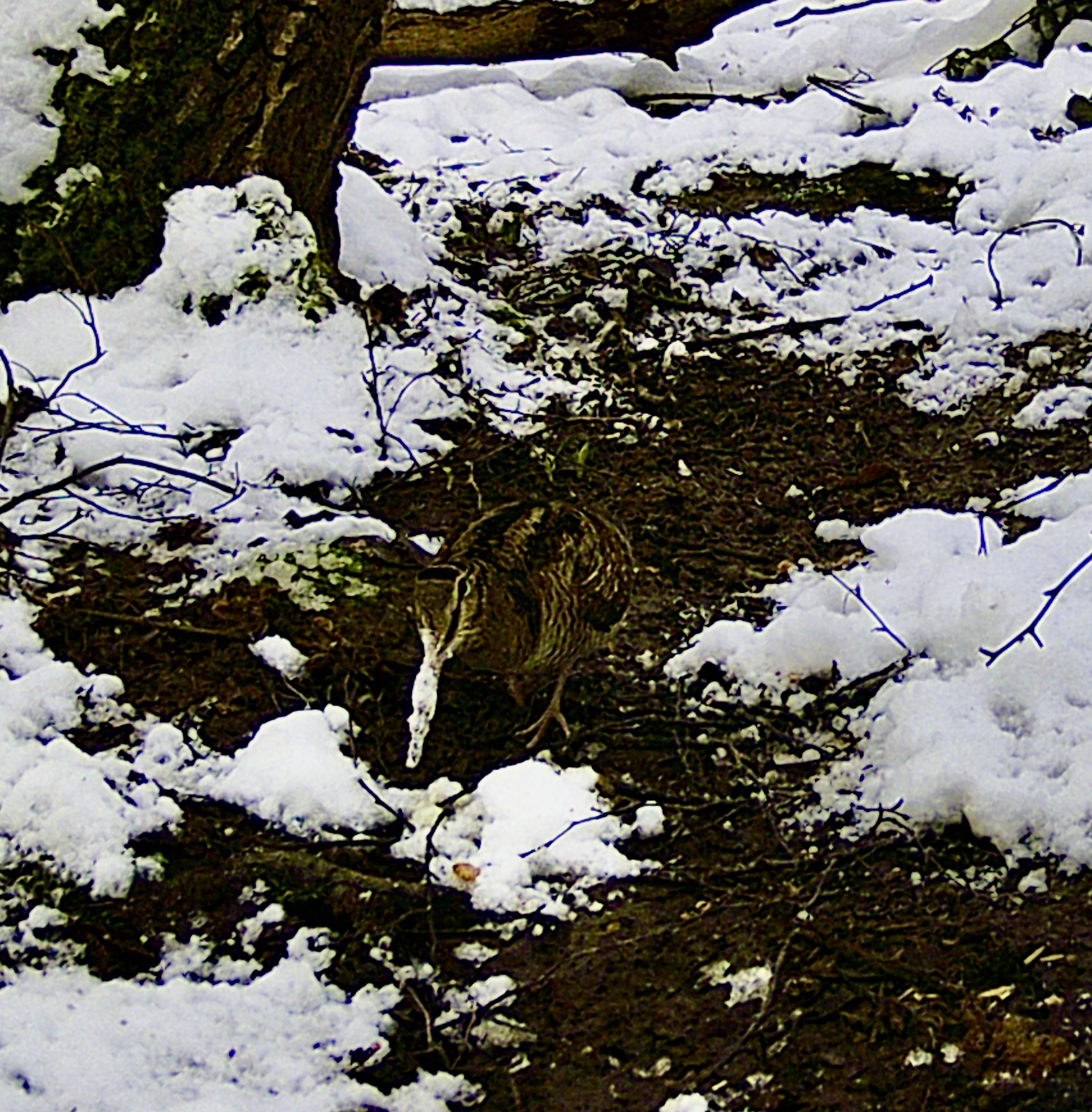
Woodcock feed by probing their long beak into the soil and they would not survive if they stayed in colder climes where the ground will be frozen for most of the winter. This country, however, does have its own adverse weather from time to time and I love this photo from our wood in February 2021:

The snowy bill of the woodcock, which has been stuck into the ground to search for invertebrates

Blackbirds also arrive in the UK for the winter from the colder parts of Europe, boosting our resident population. There are five blackbirds in the photo below, taken this week in the wood, which is something that we would never see during the summer:

I don’t think that blackbirds get the appreciation they they deserve
November 2021. A continental blackbird being ringed in the meadows. It is slightly bigger and heavier than our resident blackbirds with a longer wing length and a blackish bill. Although not noticeable on this bird, some continental individuals also have breast and mantle feathers with grey edging giving a scalloped effect

There has been a lot of rain and dull, grey days recently and these conditions are not good for the trail cameras. However, I have got the following photos of the birdlife of the meadows at this time of year:

Starlings breed here in the spring but it is fairly unusual to see one at other times of year
The ringed female kestrel has been here hunting most days
And the tawny owls are around most nights
We have heard both a male and a female calling
Green woodpeckers primarily eat ants and their larvae, slurping them up with their long, sticky tongue. However, at this time of year, ants will be dormant and much more difficult to find. This bird has mud on his beak showing that he’s still probing the soil, but for now he will be taking other soil invertebrates as well as ants
Another wasp spider cocoon, full of overwintering baby spiderlings, has been discovered by a magpie
There are still plenty of hawthorn berries remaining on the hedgerows. Often they will be all gone by now

An area of our back lawn between a cherry and an apple tree looks like it has been keeping the badgers entertained:

Badgers are omnivores, eating a wide range of different foods, but they particularly like to dig in the soil for worms and other invertebrates such as leatherjackets and beetle grubs. The roots of the trees create a more complex soil structure and this area will no doubt be harbouring more insects and grubs than other parts of the lawn

We have a trail camera looking at a badger tunnel entrance on the steep cliff below the meadows. Recently there have been a lot of photos of badgers emerging from this hole and hardly any of them going in. I am taking this as evidence that this low tunnel is connected to the rest of the sett further up the slope:

At the bottom of the cliff is the beach and over the years we have lots of photos of foxes carrying fish. A fox this week has got itself a dogfish, which it has carried back up the cliff and is about to go under the fence and into the meadows with it:

We hypothesize that the foxes hang around night fishermen down on the beach, looking for an opportunity to steal their catch. The other possibility is that they find dead fish washed up on the shoreline

The candlesnuff fungus, Xylaria hypoxylon, that we have growing in the meadows this winter, is one of the very few British fungi to show bioluminescence, although it glows too weakly to be detected by the human eye:

Over in the wood there has been another sighting of an unknown mustelid:

I presume that this is the same animal that our woodland neighbours caught on their trail cameras last month:

It is probably a polecat/ferret hybrid because of the amount of white in its fur
Jays always look so comical when they bathe
A sparrowhawk bathing with the red stems of dogwood behind

I was in Maidenhead in Berkshire again recently and went on a birdwatching trip to the nearby Little Marlow gravel pit. It is always refreshing to see birds there that I wouldn’t normally see at home:

There are some mature limes near where we park the car in Little Marlow and we invariably see jackdaws here. But, for the first time, we noticed that they are using holes in the trunks of the trees created by fallen boughs
Ring-necked parakeets are common in the Maidenhead area but back in East Kent we haven’t ever seen one in the meadows or in the wood
Red kites are so common these days in Berkshire that I have almost stopped noticing them. One was consuming some carrion at Little Marlow gravel pit – presumably a dead gull. These birds are yet to reach us in East Kent
The highlight of the trip was a pair of whooper swans, with their yellow-and-black beaks. Although a very small number of these birds breed in Scotland, they mostly breed in Iceland and then come to the North of Britain and East Anglia to overwinter. We hadn’t seen whoopers at Little Marlow before and were very excited. This pair of birds stayed for a few days on the lake but have now moved on

I finish this week with the absolutely gorgeous Willesborough Windmill near Ashford. We recently accompanied our train-mad young grandson to an exhibition by the Ashford Model Railway Club which was being held in a barn alongside the mill. This windmill, which can still grind flour, is really close to the M20 motorway but we had never spotted it before or known that it existed:

The contented sound of the many starlings that seem to have made the windmill their home won out over the drone of the nearby motorway traffic

The mill is open to the public on summer weekends and we have put it onto our To Do list for 2026.

South Devon in November

There can be something so dreary about the short, damp days of November and we like to get away if we can. Last week we joined a four day Naturetrek holiday based in the South Devon fishing town of Brixham, looking for what wildlife the region can offer in mid November:

Our home for the trip was the friendly Berry Head Hotel, situated near the end of Berry Head Penninsula and looking across Tor Bay and out to sea:

The Berry Head Hotel was built in 1803 as a military hospital to support the two Napoleonic forts on Berry Head. By the mid 19th century, though, it was owned by Reverend Henry Francis Lyte, vicar of All-Saints Church, Brixham. He wrote two really famous hymns whilst there – ‘Praise my Soul the King of Heaven’ and ‘Abide with Me’. The house remained in his family until 1949 when it was turned into a hotel

A number of grey seals regularly lounge around in Brixham harbour and we could hear their ethereal singing all the way along the headland at our hotel:

I took a lot of photos of them:

Britain is home to 40% of the World’s grey seal population, with about 120,000 seals calling our waters home. It’s a conservation success story, as the population had previously dropped to a low of around 500 in the early 20th century. 

Each of the seals has distinctive markings and can be individually identified by the Seal Project, a charity that monitors and protects the seals of South Devon.

A few purple sandpipers spend the winter on the harbour’s breakwater every year:

And several rock pipits were also poking around the seaweed on the breakwater:

Brixham still has a busy fishing port and a lot of the vessels are beam trawlers such as BM-15 below. The wheeled beam and some of the net has been hauled up here so that we can see it:

A heavy steel rod with wheels at either end rolls along the sea bed, pushing fish from the sea floor into the net just behind

Not knowing much about fishing, I found this diagram below helpful in understanding what was going on:

The principles of beam trawling. Image © Seafish

A lot of rusty old beams from the trawlers are stored on a jetty off the breakwater and apparently these are still sometimes used:

South Devon is the best place in the country to see cirl bunting. In 1991 this species was on the absolute brink of extinction in the UK with just a hundred pairs remaining in South Devon. But since then there has been an enormous effort to turn their fortunes around. Happily, by 2016 there were 1078 pairs – mainly still in South Devon but also now including a small population further west in Cornwall where they have been reintroduced. Hopefully the number will be even larger when the next count is done. We went up onto Berry Head to see some cirl bunting coming down to seed that is put out for them:

Female cirl bunting
And the more colourful males

Mike, our guide for the trip, has been birding in the region his whole life and had been the Devon county bird recorder for a decade. We met people he knew wherever we went which was very nice. He is also an artist and the bird illustrations in RSPB and other bird hides across the country are all his:

Mike Langman’s bird drawings in a hide we visited this week

The four day Naturetrek holiday included three boat trips – one on the deep waters of the Dart estuary, the second on the shallow, muddy Exe Estuary and the final one around Tor Bay.

There are so many lovely rivers in South Devon. The Dart rises high on Dartmoor and then flows forty-seven miles through south Devon down to the sea at Dartmouth. But the last road bridge is at Totnes, six miles inland, and below there you will need to use a ferry to get across the river. The Lower Ferry operates between Dartmouth and Kingswear near the mouth of the river. It is basically an unpowered pontoon that is pushed and pulled along by a tug boat:

The Higher Ferry, slightly to the north, travels across the river on a cable:

In February 2005 the cable came loose and the ferry, loaded with 15 cars and 34 passengers, started to drift towards the sea. Thankfully the crew managed to moor the whole thing to a buoy before anything untoward happened
Kingswear Castle was built in 1502 at the mouth of the Dart to support the larger Dartmouth Castle on the opposite bank. It is now a Landmark Trust property available to rent

The Mew Stone projects from the sea just beyond the mouth of the Dart. We saw a grey seal that had got itself a long way up the rock and would now presumably have to wait for a high tide to get safely back down again:

It did look a bit sad:

I was pleased to see a shag and a cormorant together on the Mew Stone so that I could revise the difference between them:

The shag at the back has a very different head and beak shape to the cormorant at the front
Cormorant with its lovely green eyes

Gulls around the Mew Stone:

The Mew Stone presents quite a hazard to shipping and there are navigational buoys guarding it. The day after our River Dart boat trip we had distant views back to the rock from Slapton Sands and we were amazed and delighted to spot our old friend THV Patricia working on the Mew Stone buoys. We often see her maintaining the light vessel and buoys that guard the perilous Goodwin Sands back home and it felt slightly disorientating to stumble across her somewhere else:

Along with her sister ship, Galatea, she is operated by Trinity House, responsible for the lighthouses, light vessels and navigational buoys around the English and Welsh coast.

The Patricia from our balcony at home in November 2020. We have become very fond of her over the years

One day we caught the Higher Ferry across the Dart in the minibus and drove down to Slapton Sands:

Slapton Sands is a three mile long pebble bar with the freshwater Slapton Ley and Beesands Ley behind

It was the site of a terrible disaster in April 1944 when Exercise Tiger, a large-scale rehearsal for the Normandy Invasion, was taking place there. As well as there being a friendly fire incident where hundreds of men were accidentally killed on the beach, the rehearsal was also attacked by fast German E-boats. Four ships loaded with tanks and men were hit or sunk. The total death toll of American servicemen during Exercise Tiger was an appalling 946.

A Sherman tank, pulled from the sea off Slapton Sands, acts as a memorial to the dreadful tragedy that happened there in 1944
Buzzards over Slapton Ley
This ring-necked duck, a North American bird that was presumably blown across the Atlantic accidentally, has spent the last nine winters living amongst tufted ducks on Beesands Ley

Start Point lies at the southern end of Slapton Sands:

Although it was a very windy day, we made a diversion to the exposed Start Point because we could see lots of gannets diving into the turbulent waters there.

It was actually too windy to hold my camera steady and so this is the best photo I have of the wonderful scene of hundreds of gannets diving into the water all around us

The birds were after the garfish which gather at Start Point:

The peculiar-looking garfish. Photo Wiki Commons by Zeynel Cebeci under CCA-SA 4.0

The gannets were not the only ones after the garfish though. As we stood and watched, we could see several Atlantic bluefin tuna surfacing as they hunted the garfish from below. The tuna are up to two metres long and have returned to UK waters in recent years after decades of absence. It was so exciting to see them – the highlight of the trip for me, although I am afraid that I didn’t manage to get a photo of them to show you.

From Start Point, we could see the remains of the village of Hallsands at the bottom the cliffs:

In 1891 the village had a population of 159, living in 37 houses and with a chapel and a pub called The London Inn. Most of the villagers depended on crab fishing on the sand and shingle banks out to sea that also protected the village from easterly storms. But in the 1890s it was decided to expand the Naval Dockyard near Plymouth and large amounts of sand and gravel were dredged offshore from Hallsands for the construction of the docks. But with reduced protection from its sandbanks, parts of the village started to get damaged by storms and, in 1902, the dredging licence was revoked. However, it was already too late. On 26 January 1917 a storm effectively destroyed the entire village and, by the end of that year, only one house remained habitable.

The village of Hallsands before it was washed away by a storm in 1917

It was a very cold day for our trip up the Exe estuary. Around a thousand dark-bellied brent geese overwinter on the estuary, arriving there every autumn from Siberia:

A group of dark-bellied brent geese with Exmouth in the background

The four geese in the centre of the photo below are juveniles with parallel white lines on their wings:

It was good to see the juveniles because last year there were hardly any of them at all. Apparently 2024 was a bad year for lemmings in Siberia and the Arctic foxes, who would normally be mainly living off the lemmings, were eating all the brent goslings instead

On the final day of the trip we had a most enjoyable trip around Tor Bay on a lovely sunny November day. We saw at least four great northern divers out in the bay:

And a peregrine falcon on the cliffs:

This is a female bird. Back in the spring there was another female in this territory but her feathers got badly oiled by fulmars and she was unable to fly. We learnt that fulmars can spit a foul-smelling oily fluid from their stomach as a defence mechanism and it is suspected that sadly the previous female peregrine perished as a result

The normal prey of the peregrines are the feral pigeons who nest on the cliffs:
A feral pigeon set against the startlingly red sandstone Devon cliffs

There is a mussel farm close to Brixham harbour, as well as this oyster farm further out into the bay:

The oysters grow attached to ropes that hang below the floats

I have a soft spot for herring gulls and we had a close encounter with quite a large group of them out in Tor Bay. The skipper threw some bread from the boat and in no time at all we were being hotly pursued:

It was an amazing sight:

Since they were keeping pace with the moving boat, it was easy to take photos of them in flight:

This adult had a very full crop:

A juvenile with the urban sprawl around Tor Bay:

There was some in-flight bickering:

But they were willing to put in a lot of effort just to claim a crust of white bread:

I have probably included more herring gull photos than I should, but it was a fantastic sight and I can’t make a decision on which to leave out:

We had had a great time in South Devon, seeing and learning a lot. Despite a poor weather forecast it actually scarcely rained at all and, although it was certainly cold and windy at times, we consider ourselves very fortunate. After the trip we headed even further west to Cornwall to spend a few days with one of our daughters and her family who have recently moved to the lovely town of Perranporth on the north coast.

It had already been a boat-heavy week with three boat trips and an admiration of the Brixham fishing fleet, but we rounded this off with a visit to the excellent National Maritime Museum in Falmouth. They have so many interesting vessels on display there, presented in a user-friendly way:

But all this was a long way from home. It was a seven hour drive back, which featured good road conditions and only three short stops. A lengthy journey indeed but one that, with a daughter now in Cornwall, we will be doing more frequently in the coming years:

Stonehenge taken on my phone from a moving car as we progressed east along the A303 heading for Kent and home

Wrapping Up

Wandering around the wood in early November

This week we did the November tour of the thirty dormouse boxes in our wood. This was the last tour of the year and wraps up my first full year of monitoring the dormice on my own, with Dave in support as scribe and helpful general assistant.

The tail of a juvenile dormouse with a sweet little white tail tip. There has been a catastrophic 70% decline in the country’s dormice population between 2000 and 2022 and these lovely animals are thankfully now heavily protected by law. I trained for nearly three years before earning my licence to disturb them

Looking back at my records, I see that last November there were no dormice left in the nest boxes, all presumably having gone down to ground level to hibernate. This November, however, we found eight juveniles. This may be an indication that the temperatures until now have been relatively mild and/or that the summer has been a really good one and the dormice have unusually had second broods. If so, it would probably be these second brood juveniles that are still around to finish fattening up before hibernation.

A juvenile female in box 18 weighing 19g. Dormice will lose about 30% of body weight during hibernation and it is thought they need to weigh at least 15-18g in order to have a chance of surviving the winter
These two female juveniles were together in box 26. The one on the right was a very healthy 26.5g but the one on the left, with another white tail tip, weighed in at only 14g
Before a dormouse goes into its small bag to be weighed, it is handled in order to establish its sex and breeding condition. They are beautiful little things that rarely bite and do not smell
The same cannot be said for these yellow-necked mice in box 25 who are much more likely to bite and do have quite a strong smell. This is an adult male and female and there was at least one juvenile in the box with them
The yellow-necked mouse nest. There is a lot of grass in there and no obvious hazel leaves as you might expect in a dormouse nest
We also found a pygmy shrew in box 3, that you can perhaps see on the side of the box above. These tiny little things are in constant motion and consequently are difficult to photograph. They don’t seem to make their own nests in the boxes but do regularly squat in a dormouse nest that is no longer being used
They have a strange dumpy shape and quite a significant nose and tail

This week dormice were found in nests in seven of the boxes, but an additional seventeen boxes also contained empty dormouse nests. This means that, now at the end of the season, twenty-four of the thirty boxes had dormouse nests in them and a further two had yellow-necked mice nests. In contrast, by November last year, only ten of the boxes had dormouse nests and two had yellow-necked nests. I would say that this year has definitely been a good one for dormice

Many of the boxes have been under attack by grey squirrels and will need replacing over the winter like box 25 here. This one still has my duster plugging up the hole at the back. Only one duster is ever in play during a tour so that you will notice if you accidentally leave it stuffed in a box
Two of the boxes had been completely ravaged by the squirrels. There had been a lovely dormouse nest in this box 20 last month
This distinctively-shaped snail was attached to one of the boxes. I believe that it is Cochlodina laminata, the plaited door snail
The dog often accompanies us as we go round the boxes. She is very patient, but finds it a bit boring

The starling murmuration is one of the UK’s most iconic winter wildlife spectacles. In the autumn starlings from Northern Europe arrive to overwinter here and greatly bolster the ranks of our own resident birds. During the day they spread out to feed but then, as dusk approaches, birds from a wide area will fly back to congregate at a safe roosting spot. Studies have shown that the birds can fly as far as thirty miles to get back to their roost before dark. This is often in reedbeds, where the surrounding water makes it more difficult for predators to reach them while they sleep. Some of the sixty-one piers dotted around the UK’s coastline can also provide a similar safe haven for them.

One of our sons has recently moved to Brighton and one evening this week he ventured out to capture the Brighton piers’ starling murmuration on his phone:

Jonny’s great photo of the Brighton starling murmuration with Brighton’s Palace Pier in the background

Sometimes the starlings arrive and disappointingly shoot straight in to roost. But other times, especially if the day is mild and calm, they will first put on an amazing aerial display, creating mesmerising patterns whilst flying in absolute synchrony.

Once they have finished their sky dancing, they settle down under the pier to roost up for the night:

Thermal image from the BBC website, taken when Autumnwatch was covering the starling roost at Aberystwyth pier in 2010. All the yellow spots are starlings perched on the steel girders under the pier

We have wrapped up warm and tried to see starling murmurations several times over the years but have mostly been unsuccessful. We were once at Ham Wall RSPB reserve in Somerset when literally hundreds of thousands of starlings streamed past us but sadly went straight in to roost in the reeds without murmurating first. Ham Wall is a famously large starling roost where numbers vary but have apparently got up to a million birds at times.

My most successful attempt was at Otmoor RSPB reserve near Oxford in December 2019. I have no idea how many starlings were involved but it was a very magical wildlife experience:

Otmoor RSPB reserve December 2019
Otmoor December 2019

We do have a small murmuration here in East Kent at Stodmarsh Nature Reserve near Canterbury where there is a sizeable reed bed. I would like to attempt to see that this year.

As we now approach winter, the trail cameras have started to fog up with condensation at times. Nevertheless they have managed to come up with some pretty good stuff this week. A sparrowhawk takes a bath in the wood:

And another sparrowhawk is appearing a lot in the meadows at the moment:

And I’ve been seeing and hearing tawny owls in the meadows too:

I would love to know where they nest.

Always a pleasure to see the kestrel that was ringed in the meadows in 2019:

Here she is out hunting nearly an hour before it got properly light:

It is a relief to see her right eye is now back to normal because, in early October, there was something very wrong with it indeed:

Photo from October
It looked like there was a blister on the lower eyelid. This lasted about a week before getting better.

The magpies are still eating wasps:

And working through the remaining acorns on the holm oaks:

We don’t often see meadow pipits in the meadows but there have been a few around recently:

The badgers should be slowing down about now and going into their winter torpor. However, they are still prepared to expend some energy on play fighting:

There are four of them although it is quite unusual to see all of them together at the moment:

This is not the first time I’ve seen the foxes carrying Bonio-style dog biscuits. Presumably someone is feeding them these down in the village:

On one sunny, still morning I was amazed to spot a common darter at the wild pond. I don’t think I’ve ever seen one so late here before:

Common darter on 9th November

One evening this week there was apparently a chance to see the Northern Lights. We would absolutely love to see them and went out before bedtime to have a look. The skies were clear but sadly there was no sign of any colourful lights. We did get a bit distracted by a very bright Jupiter and four of her moons though. She actually has 95 moons but Io, Europa, Ganymede, and Callisto are the largest:

I am going to wrap up this week by mentioning our visit to the Cavell Van which has been put on temporary display at Dover Marine Station – or Cruise Terminal 1 as it is now called:

Dover Marine Station opened initially for military use in 1915 but finally closed to passengers in 1994 following the demise of boat trains and the opening of the Channel Tunnel. It is now used as a cruise terminal
Van 132 was built and kitted out to carry the bodies of three people who were repatriated after the First World War. Edith Cavell was a nurse who was executed by the Germans because she helped more than two hundred Allied soldiers escape German-occupied Belgium. She was returned to England with full military honours in May 1919. The body of Captain Fryatt, a brave merchant seaman who was executed for attempting to ram a German U-boat, arrived in Dover in July 1919, and the Unknown Warrior was carried up to London in the van in November 1920 before being buried in Westminster Abbey. His is now one of the most visited graves in the world, and the only one in the Abbey that it is forbidden to walk on.

After arriving at the Naval Pier at Dover in 1919, Edith’s coffin was put onto a horse-drawn hearse which, together with a military guard, processed along Dover sea front lined with throngs of people who had come to pay their respects:

She then spent the night in Van 132 at Dover Marine Station:

Van 132 subsequently went into mainline service until she was retired in 1967 and left to rot away in obscurity:

However, happily she was eventually rediscovered and, after fundraising and a grant from the Heritage Lottery Fund, was renovated in 2009.

A replica of the Unknown Warrior’s coffin now rests inside the van along with information boards about Edith Cavell, Captain Fryatt and the Unknown Warrior

It was no doubt an enormous endeavour to return the Cavell van to Dover from its normal resting place at Bodiam Station. The effort was certainly worthwhile though, as large numbers of people had come to see her at this time of Remembrance.

1066 Country

There is no doubt that 1066 was a turbulent year in British history. It all started in January when King Edward the Confessor died childless. King Harold was crowned shortly afterwards but his brother Tostig, Hardrada the Norwegian King and William, the Duke of Normandy, all claimed the throne instead.

Harold defeated Tostig and Hardrada at the Battle of Stamford Bridge in Yorkshire on 25th September which just left William contesting the crown. William landed with his army on the south coast of England on 28th September and Harold and his exhausted army marched south from Stamford Bridge to confront them.

William’s army crossing The Channel to invade Britain in September 1066 as depicted in the Bayeux Tapestry

The two armies met on 14th October 1066 in a field seven miles northwest of Hastings at the present-day town of Battle and the fighting lasted from 9am to dusk of that day.

This week Dave, the dog and I stayed at the very edge of this battlefield in an English Heritage cottage:

The cottage looks out over the field where around 14,000 soldiers fought nearly a thousand years ago and where the course of British history was radically altered:

Harold and his men were positioned at the top of the hill where Battle Abbey now stands, using their large shields to form an impenetrable wall. The Normans were at the bottom, in the foreground of this photo:

Now that it is November, the site is closed during the week so, rather wonderfully, we had the entire place to ourselves

This drawing from an information board is of the same view on 14th October 1066:

Harold’s men forming a solid shieldwall at the top off the hill

It is estimated that there were somewhere between 6,500 and 10,000 deaths on this field that day.

Towards the end of the afternoon, King Harold himself was killed:

The Bayeux tapestry shows him being shot through the eye by an arrow, although this version of events is disputed. France is loaning the Bayeux tapestry to the UK next year and it will be on display in the British Museum by the autumn

The battle was a decisive victory for William the Conqueror, who was crowned king soon afterwards, marking the end of Anglo Saxon rule in Britain. In 1070 William founded an Abbey at the top of the field where Harold fell as a memorial to the Battle of Hastings and as an atonement for all the men who were killed on 14th October 1066.

Much of the surrounding land was then preserved as the Abbey’s great park, resulting in it being grazed but unploughed for a very long time, probably since the medieval period. This has allowed yellow meadow ant colonies to flourish in some parts of the battlefield, within enormous anthills that have been there for hundreds of years:

In the nearby village of Crowhurst, the Crowhurst Yew is a living witness to those tumultuous times in 1066. This tree is thought to have been planted around 700AD and would have already been three hundred years old when William and his army passed by on their way to the Battle of Hastings a thousand years ago:

The Crowhurst Yew in Sussex is a female tree and some of her berries have been grown on and planted around the country

This ancient 1,300 year old yew is growing in the graveyard in St George’s Church in Crowhurst in Sussex. In a ridiculous and confusing coincidence, there is another ancient yew growing in another St George’s Church graveyard in a second village called Crowhurst, but this time in Surrey. Both trees are called ‘The Crowhurst Yew’ but the Surrey yew is much older at 4,000 years old:

We passed through Surrey this week and took a short diversion to see this second Crowhurst Yew and I have to say that it is a completely amazing tree. In 1820 the centre of the tree was hollowed out to create a room with a door in which the parish council met for a while. As they were hollowing it out, a canon ball was discovered embedded in the wood, presumably from the English Civil War, another turbulent time in British history
The Surrey Crowhurst Yew is a male tree and so won’t be producing any berries

Whilst we were staying in Battle, we decided to spend a day in Romney Marsh, seeing some of the distinctive churches there. The most iconic of them all is the tiny Church of St Thomas Becket which stands in solitary isolation out on the marsh:

St Thomas Becket, Fairfield

We had to collect the enormous key for the church from its closest house:

And walk to the church across wet, sheep-grazed fields:

Although the church itself dates back to the 12th century, the interior of the church was restored in the 18th century and was surprisingly fitted out with white box pews and a triple-decker pulpit:

All of the Romney Marsh churches we visited that day had box pews
There was a photo in the church of it surrounded by the flooded marsh in November 1960

The Church of St Augustine in Brookland was also very memorable with its detached wooden bell tower and its strange stable-door style entrance:

In the 12th century an open framework was built to take a large bell to warn against floods and invasion. This bell framework was exposed to the winds and the rains of the marsh for three hundred years before being enclosed

The amazing 12th century Norman lead font in the church is still in use today:

We visited four Romney Marsh churches in total:

The church of St Mary in the Marsh with the simple grave of E. Nesbit, author of The Railway Children, in the foreground
St Clement’s Church in Old Romney

Now that it’s November, most National Trust and English Heritage properties in the area are closed during the week. Bodiam Castle, however, was fully open and looking fabulous in the November sunshine:

In 1066 the land at Bodiam was given to Osbern Fitz Hugh by the new Norman overlord of the area but the castle wasn’t built there until 1365

In the centre of the photo below is the castle gatehouse, the top floor of which is an important maternity roost for Daubenton’s and Natterer’s bats.

Daubenton’s bats fish insects from the surface of water using their large feet or tail. The Natterer’s bat has broad wings which allow it to fly slowly and prey on a wide variety of insects including taking spiders from their webs

I was surprised to see that visitors are allowed to walk through the rooms in which the bats roost, including during the summer when the bats will be breeding:

Bat droppings on the top floor of the gatehouse:

We saw Egyptian geese on the battlements:

And a load of enormous carp in the moat. Presumably they are fed because they were very interested in any human peering in at them:

The weather forecast for our stay in 1066 Country had been pretty poor, but actually we were quite lucky with the early November weather. As we walked the dog in some of the many woods in the area, there were plenty of rich autumnal colours to admire:

The RSPB’s Fore Wood near Crowhurst
Park Wood near Appledore
Bedgebury Pinetum

It is always a bit nerve-wracking taking the dog with us on holiday because she is generally quite anxious of things. But we are conscious that she is getting older and find ourselves wanting to spend as much time with her as we can.

She had her twelfth birthday while we were away
A birthday treat of a tub of dog ice cream at the National Trust cafe at Bodiam Castle

I have mentioned quite a few churches already in this post but will finish with one more. St Mary’s in Battle has installed a river of poppies cascading from its bell tower for tomorrow’s Remembrance Sunday:

There are over 10,000 handmade poppies, including knitted, crocheted, and felt flowers, making up this community art installation to mark the 80th Anniversary of the end of the Second World War.

Community groups, schools, care homes, and residents worked together to produce this memorial and I think that they should all be really proud of what they have produced.

Crests in Autumn

One sunny morning this week John the bird ringer, newly back from visiting his son in Australia, returned to ring in the meadows. His first day back with his nets was a triumph because he caught six firecrests which amazed us all. Along with their more common cousin, the goldcrest, these are Britain’s smallest birds and what a privilege it was to see them up close:

This is a female firecrest that was born this year

These tiny birds only weigh about 5g and, to put that in context, six of them would weigh the same as a small bag of crisps. They like to poke around in conifer trees to find invertebrates to eat, such as small spiders and moth eggs. At this time of year firecrests and goldcrests are arriving from Scandinavia and Russia to spend the winter here.

They have a lovely olive green back
This female firecrest does have bright orange crest feathers but they are not quite as vibrant as a male’s
This male’s markings were generally crisper and brighter
And he does have a strikingly orange crest

John also caught a goldcrest, which is a similar size to the firecrest but lacks the black stripe through the eye and the white stripe above it. The crest feathers are also more yellow than orange:

This is a female bird. A male goldcrest does still have some orange feathers in its crest although these might not be immediately obvious
The yellow crest of the female goldcrest

A male blackbird that John caught weighed in close to 100g, twenty times more than one of the crests:

All in all he had a very successful morning’s ringing, also catching long tailed tits, a chaffinch and a great tit amongst others. As well as these birds in his net, he saw a stonechat in the hedgerow next to him and siskin, meadow pipits, goldfinch, house martins and a swallow flying over.

This week we have had further insights into the very varied diet of a magpie. They continue to devour next door’s walnuts:

And assist the jays in stripping the holm oaks of their acorns:

A pair of magpies were ringed here two or three years ago

But I have never seen them eating wasps before:

I suppose that they are not going to be bothered if the wasp stings their beak and they’ll be alright so long as the insect is properly dead before they swallow it

There have been several other photos of a magpie with wasps and large flies this week, which is strange since it’s something I’ve never seen before now:

In my last post there was a surprising photo of a magpie eating a wasp spider cocoon. This week we discovered another of these cocoons that had unfortunately been dislodged and flattened where Dave had been doing a bit of tractoring recently:

The innards of the cocoon have been pulled out, exposing hundreds of baby wasp spiders. Although the young spiders hatch from the eggs before winter, they would not ordinarily emerge from the sanctuary of egg-sac until spring

The light was fading fast and the spiderlings were tiny, but I did my best to get a decent photo of them.

These baby spiders no longer had the shelter of the cocoon and there is still a whole winter to come. The best makeshift egg-sac I could think of was an old gardening glove. I tucked them all up cosily within it and buried it deep within the vegetation:

The spiders’ new ‘cocoon’ before I pulled the long grasses over it. Let’s hope that’s good enough and they get through the winter

Tawny owls have been hunting around the meadows at night:

And the pair of pheasants that arrived last week still remain with us and have managed to make an appearance on almost every trail camera:

There has been a lot of badger activity recently as the animals prepare for winter.

Fresh new bedding being dragged backwards to the sett

The meadows are at the top of a steep cliff, covered in impenetrable vegetation. Last winter we put a trail camera a few metres down the slope, pointing at a badger hole that was being much frequented at the time. However, all summer there has been very little activity there and it had developed an air of abandonment:

A fortnight ago the burrow opening on the cliff was looking very unused

The cliff is seriously steep here, to the extent that it would probably be sensible for Dave to get roped up when he goes down to collect the camera card. He doesn’t actually get roped up but he does, I hope, take great care.

Looking down the tunnel

Recently lot of housework has been going on in this burrow:

Digging at the entrance, with a cloud of soil flying out behind
A badger with its fur all in disarray as it emerges backwards from the tunnel dragging old bedding
There are now a lot of fresh diggings at the entrance

Much lounging around has been going on there:

And also a surprising amount of mating given the time of year:

Although badgers mainly mate after the cubs have been born in February, it can happen throughout the year. Irrespective of when they mate, however, there is delayed implantation in badgers with the fertilised egg not becoming implanted into the sow’s uterus until the autumn, timed so that the cubs are born in February

Once the cubs are born, the female doesn’t allow the male anywhere near them for a while. I have a theory that this section of the tunnel network is where the male will live in seclusion during that time.

Of course the pheasants turned up at this burrow on the cliff as well:

Over in the wood we have had some sightings of an unidentified mustelid this autumn:

Our woodland neighbours have managed to get this fantastic trail camera photo of what I suppose to be the same animal:

They have sent the image to the Vincent Wildlife Trust, a charity heavily involved in conserving threatened mammals, to get their thoughts. But that white band on the chest in particular suggests that this is a polecat/ferret hybrid rather than a purebred polecat
Polecats in Denmark. Photo Wiki Commons by Malene Thyssen CCA-SA 3.0

A pair of jays take time off from collecting and burying acorns to have a bath:

And sparrowhawks also love to bathe:

As, it appears, do tawny owls, even in late October:

Dormice cannot be presumed to all be hibernating until the beginning of December and so we can’t start coppicing or clearing trees until then. However, we have got going on the annual task of cutting down the dogwood in the marjoram clearing, which is work that won’t affect the dormice:
All the dogwood in the foreground has been cut with a hedge cutter and cleared away into piles. There is much more to be done but it feels great to have started

A sturdy ‘woodcrete’ bird box hangs at the edge of the marjoram clearing. But a glimpse of green hazel leaf seen through the hole suggests that there is a dormouse nest in there.

Although there are now thirty wooden dormouse nest boxes up in the wood, the dormice do really like to use these bird boxes as well. In fact they almost appear to use them preferentially, possibly because they are more insulated from temperature variations. We don’t look in these bird boxes when we do the monthly dormouse tours and so any dormice in them remain uncounted

It was a very special moment indeed back in October 2020 when we were clearing old bird nests out of the bird boxes and we found a dormouse instead. This was the first time we realised that we had dormice in the wood:

A dormouse, or a Ginger Ninja as my dormouse trainer calls them, living in a woodcrete bird box in October 2020

We have been back in Maidenhead in Berkshire this week and have once more come across the herd of fallow deer on nearby Ashley Hill:

But I still haven’t managed to get a photo of the males with their magnificent antlers. I will keep trying.

A lot of beech woods were planted in the area to supply the High Wycombe furniture industry with timber, but these businesses have now largely gone. Many of the remaining beech woods are now thankfully owned and protected by wildlife organisations.

Dungrovehill Wood near Maidenhead, managed by the Woodland Trust

As Remembrance Day approaches we went to Dungrovehill Wood to pay our respects to those that died in July 1944 when a Halifax bomber crashed there:

I note that four of the men that died were only in their 20s

There is still a large crater in the ground where the plane, laden with bombs and heading for France, exploded and a moving tribute to the men is strung up along the rim of the crater:

Eighty-one years ago but their sacrifice is definitely not forgotten in Dungrovehill Wood.

Clara’s Grave

Our daughter Lizzie has been off truffle hunting in Italy this week:

Truffling with Gianfranco and his dog Mina in oak and white poplar woods in Piedmont, Northern Italy

The dog found four white truffles whilst Lizzie and Sheff were with them. The truffle mycelium forms a symbiotic relationship with the tree roots where the truffle gets sugars from the tree and the tree gets water and minerals from the truffle mycelium. When the time is right, a truffle fruiting body will form which develops slowly underground. The fruiting body wants to be eaten in order to disperse and so develops an alluring smell which gradually gets stronger as it matures. By October, the smell is detectable above ground by truffle-hunting dogs although foxes, squirrels, mice, badgers and wild boar will also be trying to dig them up to eat. They will then spread the truffle spores in their droppings.

Mina is a young Lagotto Romagnolo, an Italian breed of dog considered to be the World’s best truffle hunters
Soil flying out backwards as Mina digs out a truffle
Their dinner that night of pasta and a lot of raw, shaved white truffle on top

Autumn truffle hunting in Northern Italy looked very lovely indeed and how I wished that I was there too.

Another daughter, Sally, lives in the village of Wye in the North Downs of Kent. There has been a church in the heart of the village since early Saxon times but the early church was restored and enlarged in the 15th century to what we see today.

Dave, Sally and her husband Adam arriving for the Queen’s Platinum Jubilee village picnic back in June 2022, held in front of the Church of St Gregory and St Martin in Wye

Recently the church has launched an adopt-a-grave scheme to care for some of the older graves in the graveyard:

Sally and I have adopted the grave of Clara Dixson:

Clara was the wife of the then Vicar of Wye, but she died in 1887 aged thirty-five from complications arising from the birth of her fifth child:

Her infant son Clarence, who also died within the month, lies with her in the grave

I would love to know what happened to her four other children who lost their mother when they were so very young. At the back of the gravestone there is another inscription – it was very moving to see that her husband had came back to join her when he too passed away in 1919:

John Hulke Dixson, Priest M A, Vicar of this parish 1877-1896. Afterwards Vicar of Codicote, Herts 1896-1908. Fell asleep April 7th 1919. R.I.P

We hope that our family will now care for Clara, Clarence and John’s grave for many years to come. For now Sally and I have weeded it and planted miniature daffodils and grape hyacinths, but we will do more in the spring:

Back in August we counted 149 female wasp spiders sitting on their webs out in the meadows:

We marked some of the web positions with sticks, hoping to return later to find the egg cocoons. These are constructed low in the grasses close to the web and held in place with sticky threads:

A wasp spider cocoon that we found in December 2020.

They are large, with a diameter of around 3cm, and so should be easy to find but so far we have failed to locate a single one. The same cannot be said for the magpies, however:

A magpie with a wasp spider cocoon in its beak
The magpie then dropped the cocoon and it stuck to the perch with its sticky, silken threads. It can be seen here dangling to the right of the upright post where it stayed for several hours before the magpie picked it up once more and flew off

I had not realised that magpies were eating the wasp spider cocoons, although perhaps I shouldn’t be surprised because they seem to consume most things.

This autumn a pair of kestrels are hunting in the meadows and I’m always pleased to see them together. In this photo the female is on the perch and the male is on the camera:

Last autumn there was more than one barn owl here and I knew this because one of them was ringed and the other one wasn’t. This year there have unfortunately been far fewer sightings of barn owls generally and I haven’t yet seen a ringed bird:

It is an unusual sight to see pheasants in the meadows but two females arrived this week. The pheasant shooting season began on 1st October but these two will definitely be safe from guns here:

However, I cannot guarantee them complete sanctuary, as this photo from 2023 shows:

A great deal of excavation has been going on at one of the badger burrows in the last few weeks:

Photo from September
A badger covered in straw as it excavates soil and bedding from the tunnel. Photo from September

Small bones have been coming up to the surface in these diggings. This week there was even part of a jaw bone and we now realise that these must be badger bones:

If a badger dies underground, it is thought that the other badgers will seal it up in a chamber whilst it decomposes. This badger must surely have been young because there is hardly any wear at all on those molars:

The dog still needs to be walked even when the heavy rain and violent winds of Storm Benjamin are raging over the meadows. I finish this week with my moth of the week which is a Palpita vitrealis. It was blown out of the hedgerow and landed onto the back of Dave’s waterproof in the midst of the fuming tempest.

This moth is an immigrant to this country and no stage of its lifecycle can survive our winters

The clocks go back tomorrow and we enter the dark part of the year. I think I am going to have to suspend the Moth of the Week segment now until we can triumphantly resume in the spring.

Surveying Small Mammals

Our final day on the habitat management course at Fort Burgoyne was all about small mammal surveying. Small mammals are often overlooked but form a vital part in the food chain and are good indicators of ecosystem health. Some Longworth traps had been set up around the fort:

The Longworth small mammal trap was invented in 1949 and was manufactured by the Longworth Scientific Instrument Company Ltd. The tunnel on the right has a trip wire which gently closes the door behind the animal should it enter in for the food which has been put into the main body of the trap. Because the overnight weather forecast had been poor, the traps had not gone out until that morning and so hadn’t had very long to catch anything
The body of the trap is baited with apple, rabbit food and live meal worms and cosily stuffed with hay
The traps were covered in more hay and placed in some likely places such as at the base of this bug hotel

As we were walking round the traps, we also looked under a metal ramp and found a nest of short-tailed field voles with a mother and a rather large number of young:

Two of the baby voles scurrying away

Although many of the traps hadn’t been in place long enough to catch anything, the door of one of the traps was found to be closed, indicating that something might be inside. The entire trap was placed within a large plastic bag before opening:

Inside the trap was a vole who seemed completely unperturbed by the predicament he found himself in. He was only interested in getting on with the apple:

Fur colour and the amount of ear showing suggested that this was a short-tailed field vole
However, confusingly the tail seemed rather long. Short-tailed field voles’ tails are only a third of the length of its body whereas a bank vole’s tail is half the length of its body. This threw a bit of doubt onto the vole’s ID

But, whatever species it was, the sweet little vole was sexed and weighed before being released back into the dense vegetation.

After we had inspected the Longworth traps, we were treated to a tour amongst the wild vegetation at the back of the fort. In the Second World War structures were added to bolster the fortifications of the 19th century fort, but these are now being slowly reclaimed by nature:

There were numerous intriguing back entrances into hidden corridors and storerooms:

We saw a small patch of collared earthstar fungi growing in the grasses:

Unfortunately parts of the star-shaped collar had been nibbled away, making them less spectacular than they can often be
The fungus releases spores from that central dome

Two minuscule orange bonnets were intense pops of colour amongst the greenery:

After our walk in the rampant nature around the back of the buildings, we were then escorted down into bowels of the fort itself. Groups are only taken into the fort until the end of October, by which time the overwintering bats will be soon to arrive:

Much of the fort is hidden below ground

Some butterflies have already arrived to commence their hibernation:

This herald moth was three floors down below ground:

This handsome herald hibernating in the depths of the fort will have to be my moth of the week because it hasn’t been the weather to do any moth trapping

The Conservation and Habitat Management course, and spending time at the atmospheric fort, was very enjoyable. I must keep an eye out for other courses they might run there next year.

We did another sort of small mammal survey this week when we carried out the October tour of the dormouse nest boxes in the wood. This involved checking only twenty boxes this time, but we did find eleven dormice in nine of them.

Box 10 strapped to a hazel coppice….

…with a classic dormouse nest within:

One of the eleven dormice we found this month. This adult has a white tail tip which is a genetic feature that we always record when we see it
This boy has a lovely white chest. It’s difficult to get a good photo of the dormice because you don’t want to risk them escaping from the bag or the hand. They are nocturnal animals and its not safe for them to be out by day

There will be a November tour of the boxes but we will not be expecting to find many dormice by then. They will soon be building their winter nests, close to the ground where temperatures will be more stable. Unfortunately there is a 60% mortality rate for hibernating dormice over the winter but I do hope to see some of these dormice again in the spring.

All sorts of migrating bird species are being seen in the wood. Redpoll are about with that raspberry red patch on the top of their heads:

Redpoll are partially migrating. Some stay, some go and some arrive from other parts of Europe depending on what is going on with their food availability and the weather

The tawny owls are still frequently bathing in the pools, despite the lower autumn temperatures:

I like this photo of a green woodpecker with her red feathers half up, making her head look over-large:

We have been visited once more by an unknown mustelid but it is going to have to show its face for us to have any hope of identifying it:

The contorted fruiting bodies of the white saddle fungus, Helvella crispa, are seen every year both in the wood and the meadows. They look so strange that they are difficult to walk past without photographing:

One part of the wood has a large stand of silver birch trees:

The fly agaric fungus, Amanita muscaria, forms a symbiotic relationship with many different types of tree but one of its favourites is birch. Some autumns we see lots of this eye-catching fungus but this year there doesn’t seem to be very much about.

Two pretty fly agaric on the woodland floor this year

Below the meadows there is a long, wide stretch of shingle beach. Holm oaks grow in this shingle between Walmer Castle and the village of Kingsdown to the south and every autumn something extraordinary happens down there amongst the trees:

Dave photographing one of the many enormous fly agarics that appear out of the shingle every autumn
This is the picture he got, proving that it is often a very good idea to get down onto your tummy when taking a photo, so long as you can get back up again

It seems so peculiar that they are growing without any soil, but they are getting their sugars from the roots of the holm oaks. In return the fungal mycelium provides the trees with water and also minerals which it must somehow be able to extract from organic matter that gets trapped in the shingle.

The dog giving scale to the dinner plate-sized toadstool
There were lots of these bizarre agarics emerging from the shingle but, as you can see, the dog got fed up with being asked to pose beside them
This one was had become a bit of a drinking bowl
Another one pushing its way up though the stones

Well, I love a bit of good news and here is some from the meadows. In the last post I was so worried about the kestrel who had something terribly wrong with her eye:

I can now report that she seems largely better. What a relief:

Although she’s still being hounded by the magpies

Tawny owls are regularly hunting in the meadows at night:

And the acorns from the holm oaks are fast disappearing:

One of the trail cameras got a fantastic shot when it captured a meadow pipit on a perch. This is an unusual visitor to the meadows:

As is this fieldfare:

The meadows have also been visited by a mustelid but, even though this one is a complete blur, I can tell you that it is a weasel because it has been seen on this gate a lot this year and I’ve got my eye in for it:

John the bird ringer has now spent several weeks visiting his son in Western Australia and is soon to return. He has sent some photos of the many orchids they have seen, flowering in what is now the Australian spring. The exotic spider orchid, Caladenia nivalis, is endemic to the south-west of Western Australia:

The weird-looking warty hammer orchid, Drakaea livida, is also found only in the south-west of Western Australia. It is pollinated by a single species of male thynnid wasp using sexual deception. The part of the flower on the left resembles a female wasp and emits the same smell. When the male tries to mate with it, the flower hinges backwards and the male is pressed against the part of the flower on the right, picking up its pollen that he will then transfer onto another plant when he is next deceived.

It’s all fascinating stuff and the thought of it being spring there is most appealing. Here in the UK we are going to need to get through a winter first before we can savour the joys of spring, and it is far too early for me to begin counting down the days.