The 2025 Review of the Wood

It is now six years since we took on twelve acres of lovely mixed woodland on the edge of the Barham Downs near Canterbury. We still have a lot to learn but every year we take a few steps forward in our understanding and appreciation of the place, and here are my highlights for 2025:

Green Woodpeckers

Green woodpeckers once more nested in the old cherry tree, using the same low hole that they dug out last year.

The two adults at the nest in the beginning of May

Before long, however, there was this worrying photo of an adult flying from the nest carrying what appears to be a complete egg:

Perhaps the egg got trodden on and cracked? There certainly wouldn’t have been much manoeuvering space in there

At the end of May there was another unwelcome photo, this time of an adult carrying a chick out of the nest:

I presume that this chick had died

However, even with the removal of the egg and the chick, two demanding youngsters remained:

Then, very early one morning at the end of June, one of the young woodpeckers fledged out of the hole, stretching its wings into the big wide world for the very first time:

There is always an adult nearby when the chicks fledge, presumably giving them the confidence to emerge

The remaining chick stayed in the tree for a couple more days…

…before it too left the nest. Unfortunately the trail camera failed to capture the second fledging.

The spotty juveniles were then seen on trail cameras throughout the wood for the next few weeks bringing another green woodpecker breeding season to a satisfactory conclusion:

Dormice

2025 was the first full year for which I have held a licence from Natural England to disturb dormice. I certainly got a lot of practice because there were good numbers of dormice in the boxes and they seem to have had a good year, in our wood at least. The wood is part of the National Dormouse Monitoring Programme and, by the last tour of the year in November, twenty-five of the thirty boxes had dormice nests in them. Most of these were unoccupied by then but at some point during the year all those twenty-five boxes had had a dormouse living in them.

John the birdringer’s photo, taken when he and his wife accompanied us on the May tour round the boxes. He has taught us so much about birds over the years that I was delighted to be able to show him some dormice in return
Dormice are absolutely beautiful animals but there has been a horrifying 70% decline in their UK population since 2000. Much conservation work is ongoing to try to identify and solve the problems
Several litters of young dormice were found in the boxes this year

There are often other interesting things found in the dormice boxes. A wren nest was in box 28:

A male wren will build five to twelve unfinished nests and then escort his female round them so that she can choose the one that they will then finish building and lay eggs in. She selected the nest in box 28 and they raised their young in there, leaving one unhatched egg in the box

The lid of box 3 was stuck down with a dense silken mesh and inside was a labyrinth spider, Angelena labyrinthica. These very large spiders build big funnel webs to catch their prey in low vegetation. But when it is time for the female to produce her egg sac, she will create a labyrinth of impenetrable webbing to protect the eggs. Unfortunately she sometimes chooses to do this in a dormouse nest box.

The female labyrinth spider in box 3

Yellow-necked mice will also sometimes nest in the dormice boxes. This pair had a nest with young in box 25

Every year we also find pygmy shrews living on the top of abandoned dormice nests:

It is easy to miss the tiny shrew on the side of this box

Dormice are thought to drink dew from leaf surfaces in the early hours of the morning and also get moisture from their food of fruits, berries, flowers and insects. It is most unusual for them both to come down to ground level and to use ponds to drink, but this summer a trail camera was often catching them at one of the woodland ponds:

The Pond in the Marjoram Clearing

Before our time at the wood, water was only occasionally available in small pools that formed in the centre of some of the coppice stools. We rapidly dug two ponds, but both are in the heavy shade of the trees and have remained rather dank and lifeless. They do provide somewhere for birds and mammals to drink and bathe, but we also wanted a pond where a healthy freshwater ecosystem could establish to support the tadpoles of woodland amphibians.

In January 2023 we dug a new pond out in the open of a clearing where the marjoram grows. It has proved a popular destination for larger birds, but I think the smaller birds do still prefer the other ponds that are less exposed:

Sparrowhawk standing on the frozen pond
Tawny owl bathing in the pond in mid December

The first sign that amphibians have now started using the pond was when we saw a heron extracting a frog from it in early February:

I worried that perhaps the heron had eaten the only frog but, towards the end of February, it was exciting to see that the wood’s first ever clump of frogspawn had been laid. A momentous moment indeed:

However, unfortunately I don’t think that the resulting tadpoles fared very well this year. For a start, the weather was often hot and dry and the water level got very low. But something else rather wonderful happened as well – a tadpole predator took up residence under the corrugated green square, placed by the side of the pond to increase its water catchment area. This was the first time that I had ever seen a snake on a trail camera:

A grass snake swimming in the pond
We saw the snake by the pond several times in the spring and early summer, by which time I was fairly sure there were no tadpoles left in the water

This is an awful photo but this pair of mallards, stopping in at the pond in April, were a new species for the wood:

The other new bird species seen in the wood this year was a redstart in September bringing the wood bird list to 47

I am delighted by the way that this small, simple pond has improved the habitat and biodiversity of the wood. Over the winter we are going to add another green square on the other side of it to increase its water-catching ability and hopefully improve the chances for the tadpoles next year.

Other Birds in the Wood

A dry spell at the beginning of the year allowed birds’ muck to accumulate under the stand of silver birch at the centre of the wood – a clear sign that the wood is still being used as a winter crow roost:

We feel very privileged to have tawny owls living in the wood:

A tawny owl bathing in the wood this summer

Back in 2022 a pair of tawny owls nested in one of our owl boxes and fledged two young:

One of the Johns is licensed to ring owls and ringed these two chicks in our wood back in May 2022. John’s photo. This remains an all-time highlight but sadly has not been repeated since then
May 2022

The tawnies did again show interest in the box this spring..

…but once more lost out to the squirrels. When the squirrels had finished with the box, a pair of stock doves moved in and raised two broods over the summer:

There has been bird ringing in the wood this year. Marsh tits have declined by 81% in the UK between 1967 and 2023, so the breeding population in the wood is very precious:

Marsh tit being ringed in August this year. John’s photo

We know they are breeding here because a brood was successfully raised in dormouse box 12 last year:

Marsh tits about to fledge in May 2024

I think the peanut feeder in our wood must bring in great spotted woodpeckers from far and wide because John often seems to get them in his net:

Assessing the flight feathers of a juvenile great spotted woodpecker in August. John’s photo

And bullfinch is another species of bird that breeds in the wood every year:

A pair of bullfinch in the water and one of their recently-fledged chicks, yet to get its black head feathers, is on the right

Other Mammals in the wood

Plenty of mammals live in the wood other than the dormice. Our part of the wood doesn’t contain a major badger sett, but we do still see plenty of badgers:

We also have a population of foxes. Back in 2022 the dog alerted us to an old rabbit burrow that was being used by a family of foxes. I immediately got a trail camera on it:

The fox family in April 2022
April 2022

We have not been so fortunate since then although foxes are still clearly raising their cubs there:

A lactating vixen in May this year
One of this year’s cubs with its mother in June

The UK rabbit population has seen a major decline in recent years for several reasons including rabbit haemorrhagic disease virus. It is difficult to assess the number of rabbits currently living in the wood but unfortunately there don’t seem to be very many:

The rabbits are prey for the woodland’s resident population of foxes and buzzards. Occasional mustelids have also been seen this year who love to eat rabbit when they can:

Our trail cameras caught a mustelid several times in the second half of the year. None of the photos however were good enough to be able to identify it categorically as a polecat, a feral ferret or a hybrid between the two. Our woodland neighbour, however, did much better:

Our neighbour’s trail camera photo of a polecat/ferret hybrid in her wood in October

Invertebrates and Plants in the wood

I had long wanted to be able to run a moth trap in the wood and finally took the plunge and bought a battery-powered moth trap this year. In the event I only ran it there once but this is something that is very much on the agenda for 2026.

This wonderful male black arches moth with amazing antennae is a woodland specialist and was in the trap in August

The Kent county recorder for micro moths visited the wood in October to survey it for leaf mines. Because there are so many different species of tree, he managed to record fifty-seven different species of moth leaf mines, often more than one species on a single leaf. He also found other signs of moth activity of which we had previously been totally unaware, such as the larval case of a bagworm on the left below and the tiny orange wood balls excavated by a cherry tree tortrix moth larva on the right:

It was all completely fascinating stuff and we hope to take great strides forward on the subject of woodland moths next year.

We are much more familiar with the butterflies that are to be found in the wood. The large and fabulous silver-washed fritillaries feed on the flowers growing in the marjoram clearing in July and August:

They earn the ‘silver-washed’ in their common name because of the coloration on the underside of their wings:

The larvae of this butterfly feed on the violets that grow well in the shade of the trees

White admirals are also sizeable, although this one looks like it has had some near misses:

The larvae of these butterflies feed on the leaves of honeysuckle. Honeysuckle is a very important plant in the wood – its stripped bark is used by the dormice to weave into their nests and the long tubes of honeysuckle flowers feed long tongued moths and bees. Bats then hunt around the honeysuckle at night to catch those moths. The berries are also eaten by birds and small mammals including dormice

Another plant that grows very well in our wood at the beginning of the season is the primrose.

Dark-edged bee-fly feeding on the nectar of primroses in April. Other than the bee-flies, brimstone butterflies are the only insect on the wing in the early spring that have a long enough tongue to feed from the many thousands of primroses that carpet the ground

In June we were in the wood with a friend who has a good macro camera. He photographed a bee that we think is a white-bellied mining bee, Andrena gravida. This is quite an exciting bee for the UK:

Martin’s photo of the white-bellied mining bee

Tree bumblebees built a nest in one of the bird boxes this year:

In August I photographed a most peculiar-looking fly – the waisted bee-grabber, Physocephala rufipes, which is shown below:

If it weren’t for those fly eyes, I’d never have guessed that this was a fly at all. It is an endoparasite of bumblebees

This pellucid hoverfly, Volucella pellucens, seen in August and looking very much like Humpty Dumpty, is also a fly but its shape couldn’t be more different to the waisted bee-grabber:

There are always lots of bizarre-looking scorpion flies to be seen in the marjoram clearing in the summer:

We often find glow-worm larvae in the wood, such as this one seen in June:

Another thing on the agenda for 2026 is to visit the wood just after dark on a warm, still evening in June or July. This is in hope of seeing adult female glow-worms advertising their position to the males by glowing in the undergrowth.

My final photo is of one of the many white helleborines, a woodland specialist orchid, that appeared this May:

We would normally expect to find one or two white helleborines in the wood each spring, but this year was an extraordinary year for them and we found at least forty.

It was been another wonderful year of discovery in the wood. We are hoping to get some clearing and coppicing work done this winter and then will wait to see what 2026 brings. A very Happy New Year to you.

A Local Wildlife Site

Local Wildlife Sites are areas of land that have been identified as being especially important for wildlife and its habitats, and there are almost five hundred of them in Kent and forty thousand of them across England. They can be both public and private land which supports biodiversity, provides corridors and acts as a buffer to protect nature from surrounding land use.

The number of Local Wildlife Sites so far across England is broken down by area below:

Taken from The Wildlife Trusts website. Kent has 476 sites but Hampshire is doing particularly well with 4,132

And the percentage of land per area that is part of a Local Wildlife Site is shown here:

Also from the Wildlife Trusts website. 7.1% of the land in Kent is part of a Local Wildlife Site

On Monday we had the fantastic news that, with much help from Kent Wildlife Trust, the meadows have now been designated a Local Wildlife Site, as an extension to the existing Kingsdown and Walmer Beach Local Wildlife Site. Nothing much will change as a result, but it is a wonderful grande finale for the year.

I have to admit that the allotment ran away with us this summer and got wildly out of control. We are weeding and composting it now, so that we can start afresh next year with renewed good intentions. One day Dave half-weeded one of the raised beds, intending to finish it off the next day. In the morning we noticed large feathers on the soil and, without investigating too closely, supposed that a pigeon had come down to peck around the newly overturned soil and fallen victim to a sparrowhawk.

The raised bed where the feathers had appeared

When Dave returned to finish the weeding, though, he was very surprised to find a large duck-sized bird that was now buried just below the soil, which had then been beautifully smoothed back over. The bird had no head or feet so we are not completely sure what species it is – I think it was probably a duck though:

We had never stumbled upon a fox’s cache before. I read that they do bury excess food and usually take great care to disguise high protein prey such as this bird. Interestingly, when a fox returns to remove the cache, it will often urinate at the site as a kind of bookkeeping exercise so that it will know that it has emptied the cache even though it might still be able to smell the food.

I trained a trail camera onto the cache site and, two nights later, the fox retuned to collect the bird:

Although whether or not the bookkeeping urination occurred has not been recorded for prosperity by the camera.

John the bird ringer has been ringing in both the meadows and the wood recently. Rather extraordinarily, in the last three recent seasons in the meadows he has caught seven firecrests:

One of the firecrests was a retrap (now called a ‘subsequent encounter’). It had previously been ringed in the meadows on 28th November but had now put on a bit of weight and muscle. This is good news because it suggests that the firecrest is overwintering here and is doing very well on it.

He has also recently ringed several long-tailed tits in the meadows:

One of the long-tailed tits was also a subsequent encounter and has an amusing history. It was first ringed as a juvenile in June this year at Sandwich Bay Observatory just to the north of here. It was then recaught four times at the observatory – once in August, twice in September and once in October. You can imagine that perhaps it got a bit fed up with constantly finding itself in the ringers’ net and decided to move south to try its luck elsewhere, only to find itself once more in a net in the meadows. I wonder if we will see it again before too long?

It is unusual to catch a wren in the nets and it was lovely to see this one:

John has caught this wren twice now

Lots of measurements and observations are made before a bird is ringed and released:

There is a lovely blue sheen to the wing and tail feathers of a blue tit

I did not know that you can sex a great tit by looking at the width of the black stripe down its front. This is a male with a wide black stripe and the female would have a much narrower one:

It is now thought that all the blackcaps that are here during the summer will then migrate south for the winter. They are soon replaced with other blackcaps from the more northerly parts of Europe, arriving in the autumn to overwinter in this country. John caught one of these overwintering blackcaps this week:

On a recent sunny day, we toured the meadows to clear old bird nests out of the nest boxes. It is sometimes a bit of a struggle to remember where all the boxes are, but we managed to find eight boxes that had been used this year:

I think that these are all great tit and blue tit nests. We did also have swifts and house sparrows nesting in boxes attached to the house but we haven’t got round to those yet

Several of the boxes had been commandeered by snails to hibernate in:

A female gypsy moth had taken up residence in another box. Ignoring the snail, you can see the whole life cycle in the photo below. The hairy caterpillar is top right and the large, smooth brown cocoon is below it. The white flightless adult female is now deceased and lying just above the cocoon and snail. Finally, her brown furry egg mass is to the left of the photo:

The female adult moth will have released pheromones to attract a male into the box to mate with her before the eggs were laid. The gypsy moth is an unwelcome new arrival in this country but they are here now and there is nothing to be done about it. However, all the same, I think we will remove those eggs

Other interesting photos from the meadows this week:

I include this rather fogged up trail camera photo because it shows the rear end of a stoat – only the third time we have seen one here
A lizard hibernating in a pit under a reptile sampling square
A tiny Luffia moth larva feeding on lichen on some rope. This moth has a really strange life cycle because, other than in Cornwall, only the flightless female is known – there are no males and reproduction quite happily goes on parthenogenetically without the need for one. In Cornwall, however, there are winged males
In the south of England, buff-tailed bumblebees attempt a third generation, often relying heavily on winter-flowering plants in gardens
We do have winter-flowering heathers and mahonia to offer them at the moment and it was lovely to see these plants being used by the bees this week

I heard from our woodland neighbour that she had just seen a hawfinch in her wood. John the bird ringer was ringing in our wood the very next day but sadly didn’t see or hear a hawfinch. He did, however, hear crossbills throughout the morning. Eventually twenty-two of them landed in a nearby tree and he got fantastic views. He doesn’t carry a camera but here is a photo of two male crossbills from Wiki Commons:

These birds are fir cone specialists, but the ones John saw in the wood this week appeared to be foraging on an oak tree. Photo by Elaine R Wilson under CCA-SA 3.0

Occasionally we do hear shooting in the environs of the wood and so perhaps these pheasants are seeking sanctuary amongst the trees where the guns can’t go:

The new pond in the marjoram clearing has been getting a lot of visitors recently. A sparrowhawk here:

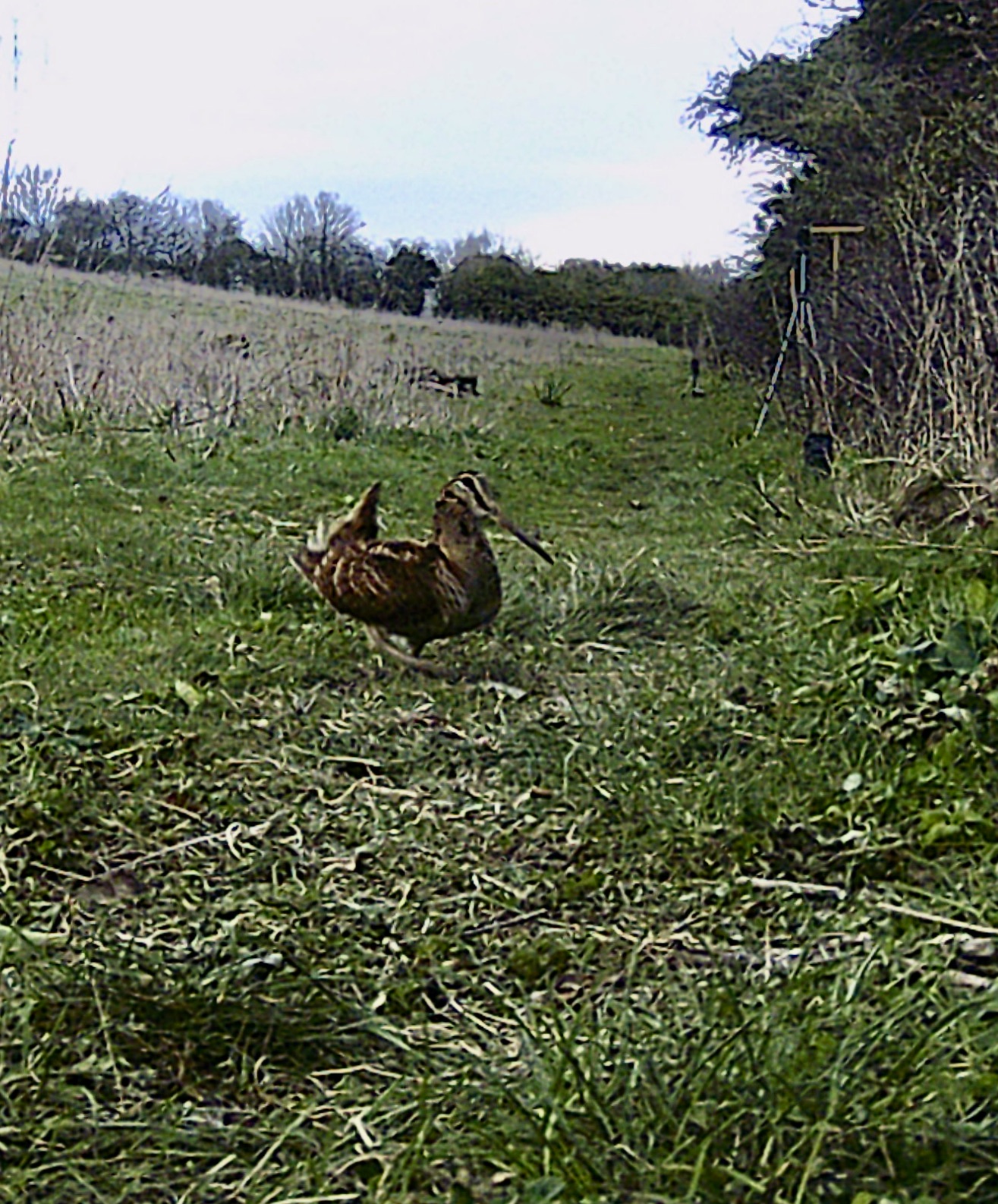
And lots of night time woodcock:

Even a tawny owl is regularly bathing there still:

A lovely woodland night time scene

Tomorrow’s winter solstice is the very deepest point of winter and is always eagerly anticipated here. From that point on the days are gradually getting longer and there is an indefinable feeling of change in the air. Like our ancestors for centuries before us, we are planning to mark the day by lighting some candles out in the meadows, celebrating a special day where light starts to win out over the darkness.

My Family’s Wildlife Year

Now that the wildlife is mostly tucked away for the winter and all is quiet out there, it is time to turn my attention to reviewing my wildlife highlights for 2025. It is truly a labour of love to trawl through the photos taken in the meadows and the wood over the past twelve months and come up with a selection of the most interesting. I will be using these in my reviews of the year coming soon! Before I start that, though, I first asked my family to send me their most memorable wildlife photo of the year. It was fun to see what they came up with, and I now present these to you here.

We have five children and I start with the youngest, Lizzie, who went truffle hunting with Gianfranco and his dog Mina in Piedmont, Northern Italy, in October.

Mina is a Lagotto Romagnolo, a breed of dog known as the best truffle hunters in the world, and she dug up four white truffles whilst Lizzie was with her. The truffle is the fruiting body of a fungus that grows underground, forming a symbiotic relationship with the tree roots. It needs to be eaten in order to disperse and so develops an appetising smell which gets stronger as it matures. By October, the aroma is detectable above ground by animals with a keen sense of smell such as badgers and wild boar. They will dig them up and eat them, then spread the truffle spores in their droppings.

Jonny, who moved to Brighton this autumn, took himself down to the seafront at dusk and captured the Brighton Piers’ starling murmuration on his phone.

The murmuration at the Palace Pier. There is the ruined West Pier at Brighton as well, at which the birds also roost

Before they left for Brighton, our daughter-in-law Hayley got amazing video footage of up to ten red kites who came to tea in their back garden in Maidenhead after she had thrown some scraps out. Red kites generally feed by swooping low, grabbing the food with their feet and not landing on the ground. However, at Hayley’s red kite tea party that afternoon most of her visitors eventually landed down onto the lawn:

Our daughter Sally has sent this photo of a rose-crowned fruit dove that she thought was the most beautiful bird she’d ever seen. It lives high in the canopy of the rainforests of Northern and Eastern Australia and Southern Indonesia and eats various fruits from the trees and vines. This is not where she saw it though – she saw it in a zoo in Honfleur when she was on holiday with her family in France this summer:

Her husband Adam found a very large elephant hawk moth caterpillar in their garden in Kent in August. The species was apparently given this common name because of the caterpillar’s resemblance to an elephant’s trunk:

But when he gently nudged it with a twig, it rapidly transformed itself into something that looks a lot more scary:

Our other son Jonty, together with his wife Ellie, accompanied us to Elmley Nature Reserve on the Isle of Sheppey back in January where we stayed overnight in shepherds huts in the heart of the reserve. We were most unfortunate though because Storm Herminia was in full swing whilst we were there, meaning that we saw very little wildlife and got very wet. By way of consolation, the wildlife guide showed us where there was a magnificent long-eared owl roosting in some deep cover. This is a bird that Jonty and Ellie had never seen and of which we had never before got such good views:

The four of us are going to try again and are returning to Elmley next month, hoping for better weather this time.

In the depths of December’s gloom, it is impossible not to be cheered by Ellie’s photo below of buff-tailed bumblebees. It was taken in July in the gardens of the large crop protection company she works for near Maidenhead:

Our eldest child Sarah moved with her family to Cornwall this summer. However, she and our little grandson stayed with us in Kent last week and visited Wingham Wildlife Park where a Bornean orangutang put on a good show for them:

All three species of orangutang are now critically endangered and zoo populations are crucial, serving as vital insurance populations and genetic reservoirs. They can also be used to raise awareness of the habitat loss due to palm oil plantations which is one of their biggest threats.

Sarah also took this photo on her phone of a hummingbird hawkmoth when visiting Trelissick gardens near Truro in Cornwall:

These lovely moths feed from the nectar of tube-shaped flowers, using their long proboscis and whilst hovering in the air – they are notoriously difficult to photograph and have frustrated me many times, even with the speed whacked right up on my camera.

We are looking forward to getting to know Cornwall’s distinctive wildlife a bit better as we visit Sarah and her family in the coming years.

My brother likes Cornwall too and he sent me this photo of a grey seal haul out on the Roseland Peninsula in Cornwall in February. What a lovely sight this is:

He also took this photo of a grey heron from the back door of his home in Somerset:

His wife, Julie, found this beautiful moth, a scarlet tiger moth, in their Somerset garden in May. It has a largely westerly distribution and I haven’t ever seen one of these:

She also found a garden tiger moth caterpillar at Three Cliffs Bay on The Gower in South Wales in April. It looks really quite extraordinary, like a piece of old badger fur:

One of my brother’s sons is in a different league to the rest of the family as far as wildlife photography goes. He lived in the US for several years before moving back to England this summer. Before he left, he took this photo of a bull moose in the Rocky Mountains National Park, Colorado:

And this amazing photo is of a subadult grizzly bear in Yellowstone National Park in Wyoming:

My sister’s wildlife photo of the year is of a lovely mallard’s nest that they found at the bottom of their garden in Berkshire this spring:

This was not an ideal spot for the mother duck to have chosen and they were worried about how she was going to lead her ducklings to the river once the eggs hatched. In the end, however, this wasn’t an issue because sadly the nest was abandoned.

My sister does have another wildlife photo, this time taken inside her house. Although this was actually in October 2024, it was so astonishing that I’ve included it anyway. She had the french windows open that day and a polecat wandered into her sitting room and had a poke around:

There are quite a lot of dogs in the family and one of my sister’s daughters actually now has three. Here is lovely little Skye who she took in to temporarily foster this year and of course ended up keeping her:

I finish this round up of my family’s wildlife year with Dave and my favourite photos. Back in May, we were with the Amphibian and Reptile Trust who were showing us the reptiles and amphibians of Dorset as part of a four day holiday. The smooth snake is Britain’s rarest snake and Dave never dreamed that he would ever see one, let alone actually hold one. This image of him with a smooth snake is his photo of the year:

Smooth snakes are only found on heathlands in Dorset, Hampshire and Surrey. It is a non-venomous constrictor, coiling up around its prey of sand lizards, slow-worms, insects and nestlings to subdue them, often crushing them to death.

In June we caught the sleeper up to Aberdeen and then the overnight ferry on to Shetland. The Shetland Isles are remote from the rest of the World and, as a result, some species have evolved in isolation and are now only found there. Before very long at all I had fallen in love with the Shetland bee:

Only found on Shetland and the Western Isles, the Shetland bee is strikingly large and intensely coloured, and is quite simply an absolute corker.

Shetland also has its own wren subspecies. Since there are so few trees to hide within on the islands, the Shetland wren is used to being out in the open and is easy to photograph:

This wren is darker than the mainland form with a longer bill and stronger legs.

I have very much enjoyed pulling together this collection of my family’s wildlife photographs for 2025. They should now be forewarned that I will be asking them again next year, so hopefully they will be ready with some more good ones!

Woodcocks and Blackbirds

John the bird ringer sent me this photo of a woodcock that his son had found resting on the deck of his ship, not far off the Norwegian coast.

The bird could well have been heading to the UK to spend the winter, but it’s not a good sign that it needed to stop off on the ship because there is still a long way for it to go. John suggested to his son that he put some minced meat out for it but we haven’t yet heard how that went. A few years ago his son also had a snowy owl on his ship which must have been a pretty amazing sight

 Although the woodcock is very obvious on the red deck of the ship, it is normally exquisitely camouflaged, disappearing from view when roosting by day on a leaf-strewn woodland floor.

A trail camera photo of a woodcock in the wood this week

There is a small population of woodcock that breed in this country but their numbers are boosted a hundredfold in the autumn when birds from north-east Europe and Russia arrive here to enjoy our milder winters. Every year a fair number come to our wood and we enjoy night time trail camera photos of them throughout the winter until they leave again in the spring.

November 2023

Back in November 2018 Dave discovered that one of these lovely birds had flown in off the sea and unfortunately straight into his study window, breaking its neck. The fact that it had just arrived at its destination after a long and arduous journey across Europe and the North Sea made the whole thing even more sad.

Note the very tips of its tail feathers are grey when viewed from above like this. Photo from November 2018
But when turned over, you can see that the tips of these same tail feathers are startlingly white when viewed from the underside

The underside of a woodcocks tail feathers are very white indeed. In fact they are 30% brighter than the white on any other bird, since it uses them for courtship display at night. The grey upperside, however, ensures that its daytime camouflage is not compromised. Below you can see the grey upperside and the white underside of the tail feathers:

Although these overwintering birds won’t be displaying whilst in this country, I do have trail cameras footage of them flaring their tail up to reveal the white. Photos from February 2021 and March 2023:

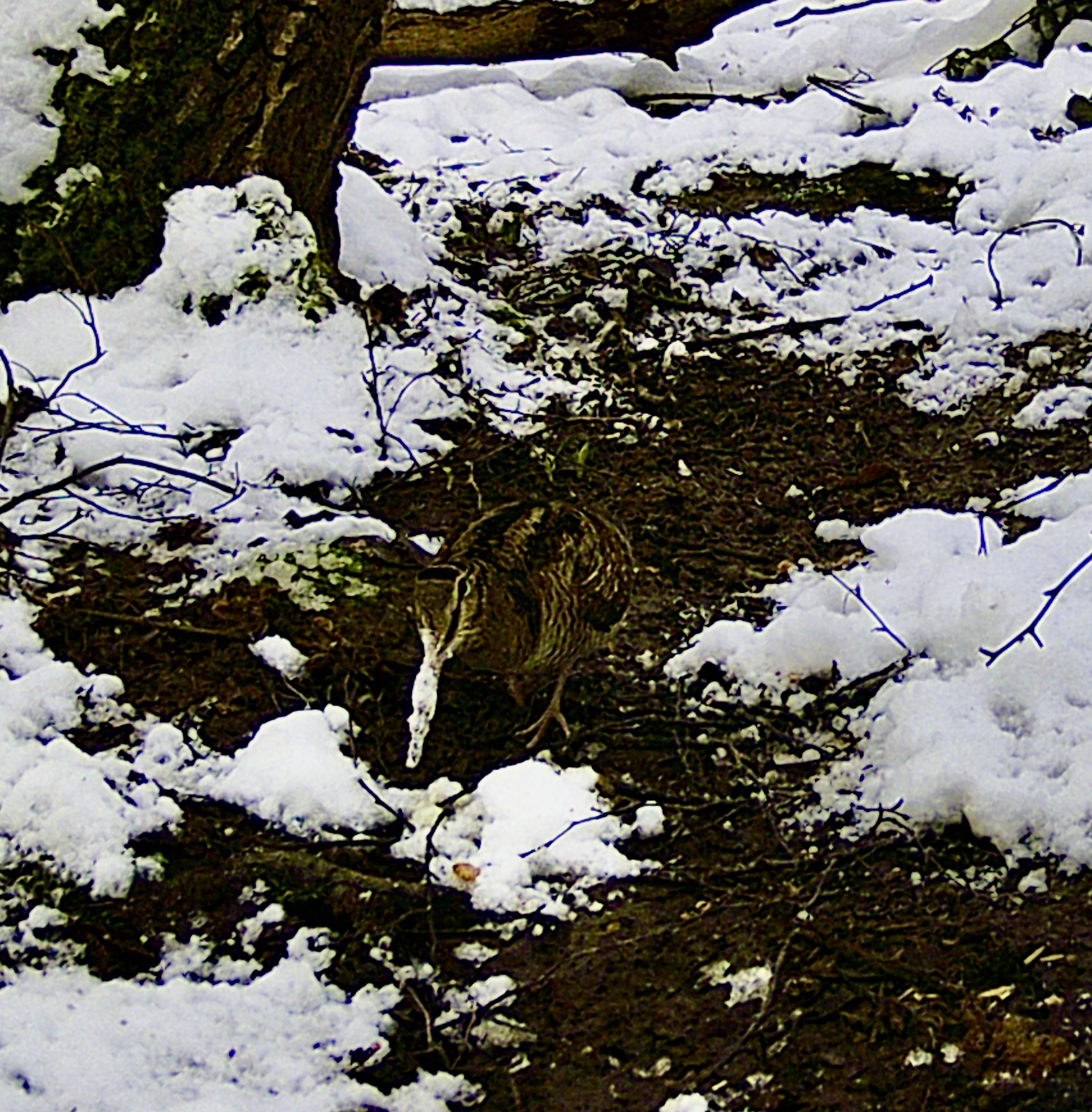
Woodcock feed by probing their long beak into the soil and they would not survive if they stayed in colder climes where the ground will be frozen for most of the winter. This country, however, does have its own adverse weather from time to time and I love this photo from our wood in February 2021:

The snowy bill of the woodcock, which has been stuck into the ground to search for invertebrates

Blackbirds also arrive in the UK for the winter from the colder parts of Europe, boosting our resident population. There are five blackbirds in the photo below, taken this week in the wood, which is something that we would never see during the summer:

I don’t think that blackbirds get the appreciation they they deserve
November 2021. A continental blackbird being ringed in the meadows. It is slightly bigger and heavier than our resident blackbirds with a longer wing length and a blackish bill. Although not noticeable on this bird, some continental individuals also have breast and mantle feathers with grey edging giving a scalloped effect

There has been a lot of rain and dull, grey days recently and these conditions are not good for the trail cameras. However, I have got the following photos of the birdlife of the meadows at this time of year:

Starlings breed here in the spring but it is fairly unusual to see one at other times of year
The ringed female kestrel has been here hunting most days
And the tawny owls are around most nights
We have heard both a male and a female calling
Green woodpeckers primarily eat ants and their larvae, slurping them up with their long, sticky tongue. However, at this time of year, ants will be dormant and much more difficult to find. This bird has mud on his beak showing that he’s still probing the soil, but for now he will be taking other soil invertebrates as well as ants
Another wasp spider cocoon, full of overwintering baby spiderlings, has been discovered by a magpie
There are still plenty of hawthorn berries remaining on the hedgerows. Often they will be all gone by now

An area of our back lawn between a cherry and an apple tree looks like it has been keeping the badgers entertained:

Badgers are omnivores, eating a wide range of different foods, but they particularly like to dig in the soil for worms and other invertebrates such as leatherjackets and beetle grubs. The roots of the trees create a more complex soil structure and this area will no doubt be harbouring more insects and grubs than other parts of the lawn

We have a trail camera looking at a badger tunnel entrance on the steep cliff below the meadows. Recently there have been a lot of photos of badgers emerging from this hole and hardly any of them going in. I am taking this as evidence that this low tunnel is connected to the rest of the sett further up the slope:

At the bottom of the cliff is the beach and over the years we have lots of photos of foxes carrying fish. A fox this week has got itself a dogfish, which it has carried back up the cliff and is about to go under the fence and into the meadows with it:

We hypothesize that the foxes hang around night fishermen down on the beach, looking for an opportunity to steal their catch. The other possibility is that they find dead fish washed up on the shoreline

The candlesnuff fungus, Xylaria hypoxylon, that we have growing in the meadows this winter, is one of the very few British fungi to show bioluminescence, although it glows too weakly to be detected by the human eye:

Over in the wood there has been another sighting of an unknown mustelid:

I presume that this is the same animal that our woodland neighbours caught on their trail cameras last month:

It is probably a polecat/ferret hybrid because of the amount of white in its fur
Jays always look so comical when they bathe
A sparrowhawk bathing with the red stems of dogwood behind

I was in Maidenhead in Berkshire again recently and went on a birdwatching trip to the nearby Little Marlow gravel pit. It is always refreshing to see birds there that I wouldn’t normally see at home:

There are some mature limes near where we park the car in Little Marlow and we invariably see jackdaws here. But, for the first time, we noticed that they are using holes in the trunks of the trees created by fallen boughs
Ring-necked parakeets are common in the Maidenhead area but back in East Kent we haven’t ever seen one in the meadows or in the wood
Red kites are so common these days in Berkshire that I have almost stopped noticing them. One was consuming some carrion at Little Marlow gravel pit – presumably a dead gull. These birds are yet to reach us in East Kent
The highlight of the trip was a pair of whooper swans, with their yellow-and-black beaks. Although a very small number of these birds breed in Scotland, they mostly breed in Iceland and then come to the North of Britain and East Anglia to overwinter. We hadn’t seen whoopers at Little Marlow before and were very excited. This pair of birds stayed for a few days on the lake but have now moved on

I finish this week with the absolutely gorgeous Willesborough Windmill near Ashford. We recently accompanied our train-mad young grandson to an exhibition by the Ashford Model Railway Club which was being held in a barn alongside the mill. This windmill, which can still grind flour, is really close to the M20 motorway but we had never spotted it before or known that it existed:

The contented sound of the many starlings that seem to have made the windmill their home won out over the drone of the nearby motorway traffic

The mill is open to the public on summer weekends and we have put it onto our To Do list for 2026.